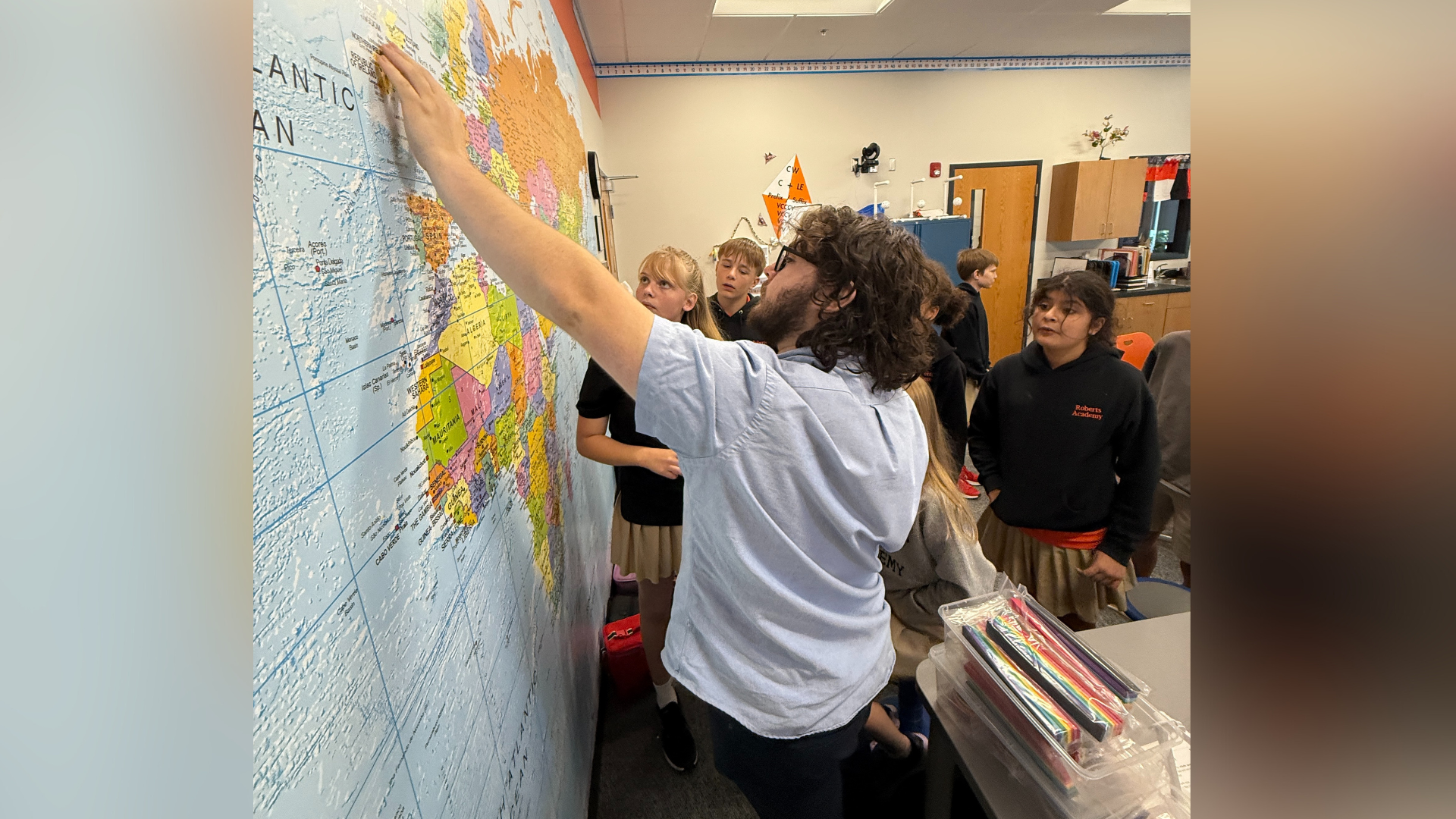
Mercer University College of Education students gained a better understanding of the diverse learning needs of children while spending time with Roberts Academy sixth graders. Secondary education majors are required to log 30 hours of observation at local public middle and high schools each semester of their junior year, and for the first time this fall, they spent 10 of those hours at Georgia’s only school for dyslexic learners outside metro Atlanta.
“It seemed to be really successful, so it’s something we want to continue in the future,” said Dr. Matthew Sroka, assistant professor of literacy education in the College of Education.
Roberts Academy, located two blocks from Mercer’s Macon campus, opened in August 2024 with students in grades 2-5 and expanded to sixth grade for the 2025-26 academic year. This addition presented a unique opportunity for Mercer secondary education students to connect with Roberts Academy while working toward their field placement requirements.
Throughout the fall semester, several juniors visited Teresa Kalmbach’s class, where they not only observed the sixth graders but lent a hand with activities.
“The goal is observation and to experience it and see teaching in action,” Dr. Sroka said. “The great thing about Roberts is Mrs. Kalmbach got all of them involved. So when they came, they didn’t just sit back and watch.”
Kalmbach said the Mercer juniors spent a few days observing and getting to know her students and the classroom. Then, they started assisting with small group time, answering questions and offering supplemental information related to the content being taught.
“We have a diverse population of learners that (Mercer students) will encounter in a general education classroom,” she said. “It’s really important they can get into this environment and see it on a small scale and start to understand the types of behavior and learning needs of these students. What we do here, it benefits all students. Being here helps them to apply it in their own practice.”
Joel Chen, a social studies and history secondary education major, enjoyed his time at Roberts Academy so much that he secured a student worker job there. He said he was inspired while watching Kalmbach work with the children and seeing the close-knit classroom environment that she had created.
“I think that this (experience) is really going to benefit me,” Chen said. “Roberts Academy uses the Orton-Gillingham (teaching) approach. Getting experience in how they’re using it, I could possibly use some form of it in my own classroom in the future. But also I’m helping these children with dyslexia, so I can maybe pick out who has dyslexia in my own classroom in the future. It’s all about helping the student and making sure they can learn.”

Catherine Spainhour, a junior secondary education and history double-major, said she helped during small group reading time and taught the students about New Zealand, which she recently visited.
“I learned how to lead small groups while helping students with dyslexia, as well as how much their learning and struggles range. I loved being able to see how they worked in the classroom with each other through their active writing activities,” she said.
The observation time at Roberts Academy also aligned well with Dr. Sroka’s disciplinary literacy course, which focuses on how specialized literacy skills can be applied to any discipline. For instance, the Mercer students learned about guided, independent and structured levels of inquiry-based learning in class and then witnessed that instruction at Roberts.
“As they work with students with dyslexia, a lot of the instruction is designed around literacy,” Dr. Sroka said. “In class, we talk about literacy theory and all these strategies that could be done in the classroom, but they actually get to see it in action when they go to Roberts.”
The College of Education has begun to build into its curriculum experiences that connect students with Roberts Academy, said Dr. Sharon Augustine, associate dean and professor of education. Health and physical education majors were the first to observe at the school, and students in the fundamentals of special education course did two days of observation and a panel discussion at Roberts this fall. Now, the recent field placement of Mercer secondary education students at Roberts sets the stage for continued observation experiences for those majors and possible practicum and student teaching opportunities in the future.
“It’s really important that we are intentional with making sure that we put our students in courses and field placements that speak to each other,” Dr. Augustine said. “We are making sure Mercer students are benefitting from having the partnership with Roberts and learning from the faculty there. There’s nothing better than sending students into an environment that you know is pouring into those Roberts Academy students, addressing an important need and helping our Mercer students get a hands-on understanding of dyslexia as a superpower and learning difference not a deficit.”
David Robertson, health and physical education instructor for the College of Education and physical education teacher at Roberts Academy, oversaw the juniors who logged observation hours at Roberts this fall. The students journaled about their time at the school, and their entries indicated the hands-on experience was very impactful to them, he said. Between their observations at Roberts Academy and a public school, they saw a variety of students as well as a variety of teaching methods.
“They’re getting to see there’s not one way to teach,” Robertson said. “You have to observe, you have to have hands-on experience, you have to be able to interact and appreciate students wherever they are. I hope they take that experience with them because every year is a new year and every class is a new class. It broadens their horizons of being a teacher.”