MACON, Ga. — Mercer University is one of 237 U.S. colleges and universities to recently receive the 2026 Carnegie Community Engagement (CE) Classification, an elective designation awarded by the American Council on Education (ACE) and the Carnegie Foundation for the Advancement of Teaching that highlights an institution’s commitment to community engagement.
“We are thrilled to once again earn the Carnegie Foundation Community Engagement Classification, after having initially received the designation in 2008 and reclassification in 2015,” said Mercer President Dr. Penny L. Elkins. “It further validates the emphasis we place on changing the world and improving the human condition, beginning with the Georgia communities where we have campuses.”
Mercer University has adopted the Carnegie definition of community engagement, defined as “the collaboration between institutions of higher education and their larger communities (local, regional/state, national, global) for the mutually beneficial exchange of knowledge and resources in a context of partnership and reciprocity. The purpose of community engagement is the partnership of college and university knowledge and resources with those of the public and private sectors to enrich scholarship, research, and creative activity; enhance curriculum, teaching, and learning; prepare educated, engaged citizens; strengthen democratic values and civic responsibility; address critical societal issues; and contribute to the public good.”
“Mercer provides meaningful and impactful opportunities for students to serve in their campus neighborhoods, throughout Georgia and around the globe,” said Vice Provost of Engaged Learning Dr. Kathryn D. Kloepper. “In this work, Mercer centers and prioritizes a deep commitment to learning, creativity, empowerment and service that prepares advocates for positive change locally and globally.”
The CE Classification has been the leading framework for institutional assessment and recognition of community engagement in U.S. higher education for the past 19 years, with classification cycles in 2006, 2008, 2010, 2015, 2020, 2024, and now 2026. The 2026 cohort includes a diverse range of institutions, with 157 public institutions, 80 private colleges and universities, and 81 Minority Serving Institutions represented among the recipients.
“The institutions receiving the 2026 Community Engagement Classification exemplify American higher education’s commitment to the greater good,” said ACE President Ted Mitchell. “The beneficiaries of this unflagging dedication to public purpose missions are their students, their teaching and research enterprises, and their wider communities.”
A listing of all the institutions that currently hold the classification endorsement can be found here.
About the Carnegie Classifications
The Carnegie Classifications are the nation’s leading framework for categorizing and describing colleges and universities in the United States. Utilized frequently by policymakers, funders, and researchers, the Classifications are a critical benchmarking tool for postsecondary institutions. ACE and the Carnegie Foundation announced a partnership in February 2022 to reimagine the Classifications to better reflect the diversity of postsecondary institutions and more completely characterize the impact that today’s institutions have in society.
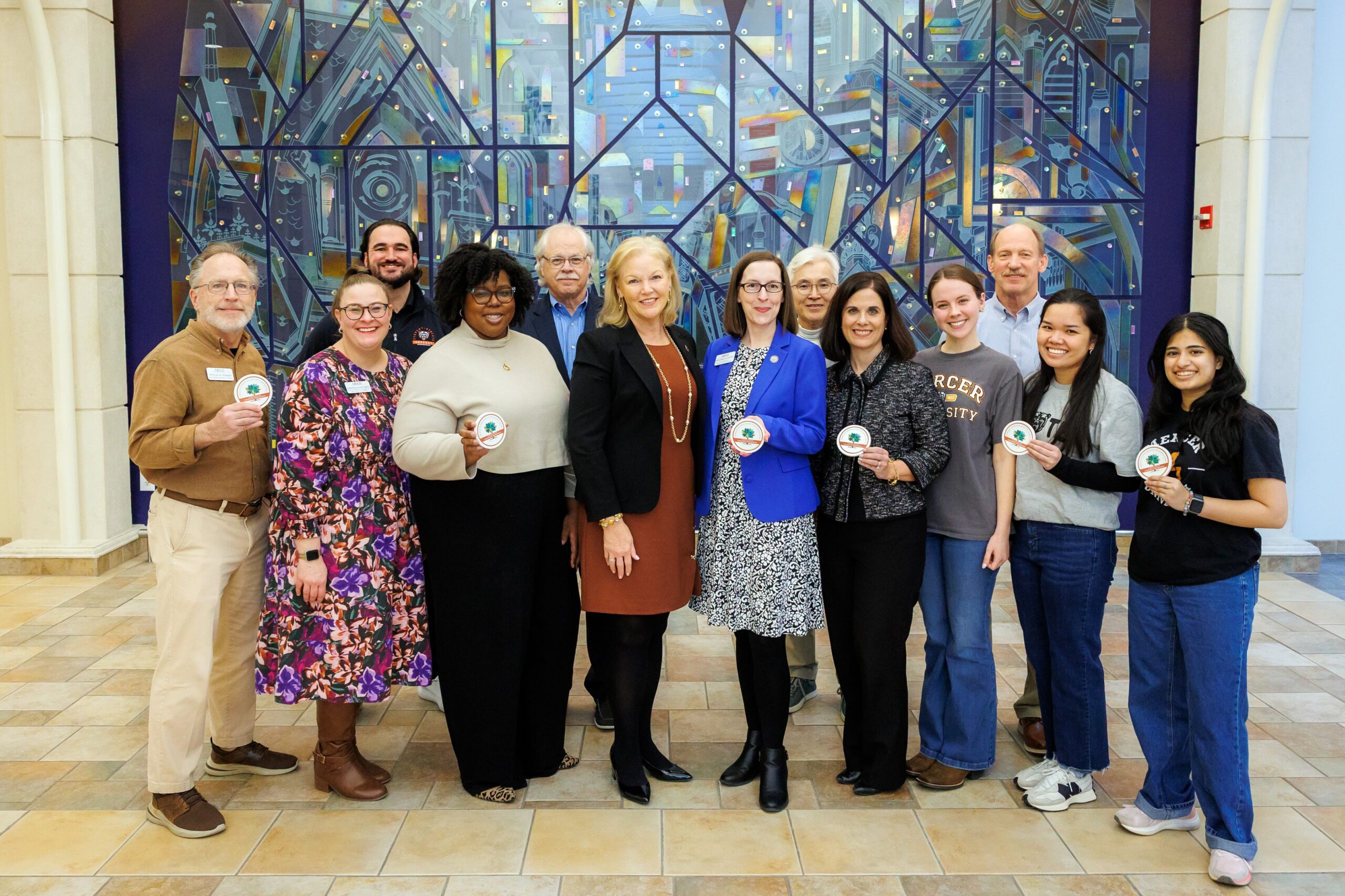
Feature image: (Front row) Vice President and Dean of Students Dr. Doug Pearson, Executive Director of Campus Life and Student Involvement Meredith Keating White, Associate Director of Engaged Learning Lauren Shinholster, President Dr. Penny L. Elkins, Vice Provost of Engaged Learning Dr. Kathryn Kloepper, Executive Vice President for Academic Affairs and Provost Dr. Lisa Murphey Lundquist, students Abigail Williamson, Cindy Cao and Sanjna Desai, (back row) Director of Student-Athlete Support Services Eric Shephard, Senior Vice President for Marketing Communications and Chief of Staff Larry D. Brumley, Professor of Biomedical Engineering and Director of Graduate Programs Dr. Sinjae Hyun, University Minister Dr. Craig McMahan. Photo by Leah Yetter