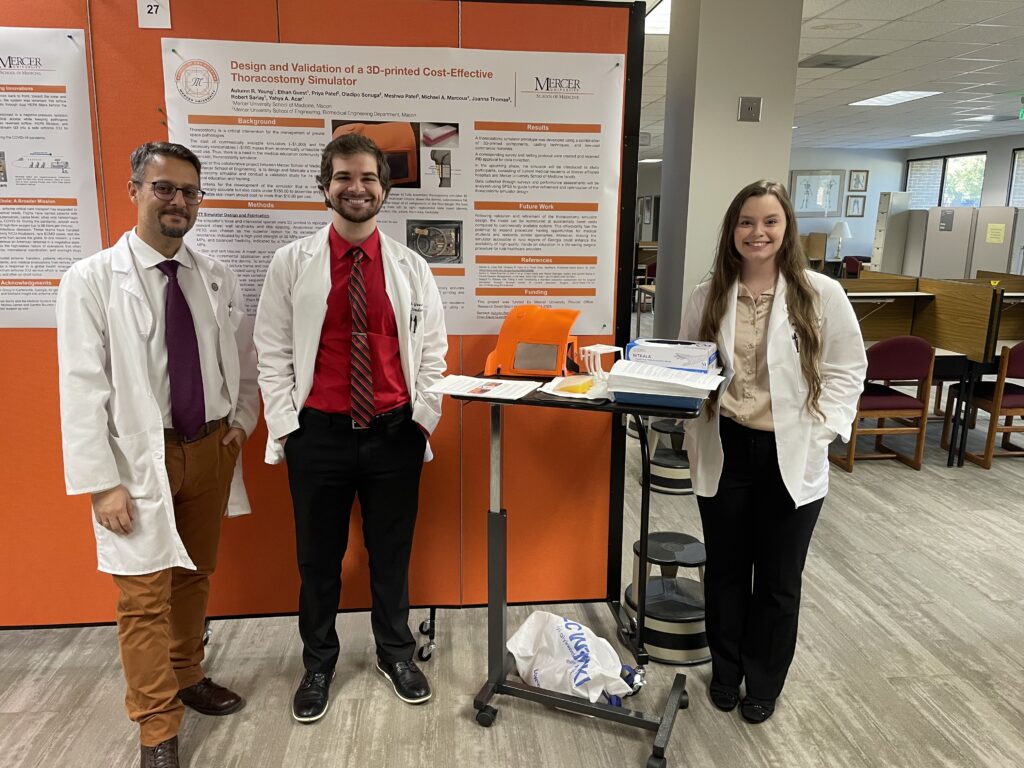
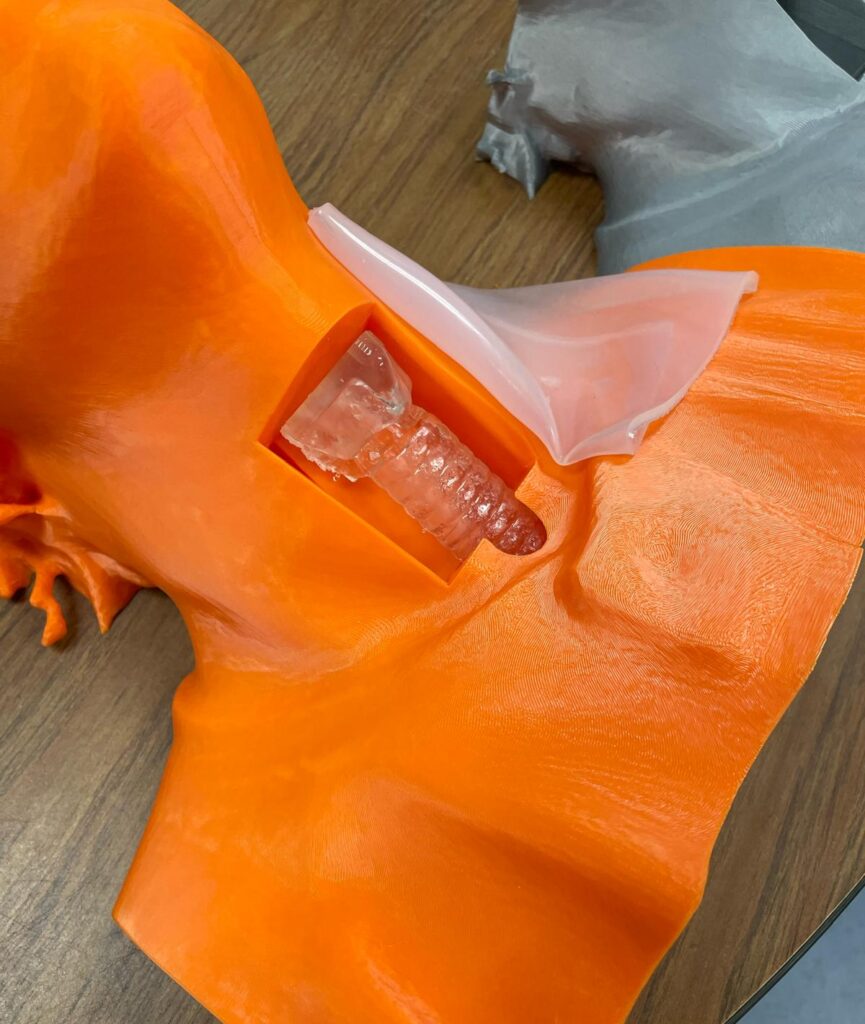
A Mercer University team hopes to bridge a gap in medical training in rural Georgia and beyond with two new low-cost simulation devices. Led by Dr. Yahya Acar, faculty and students in the School of Medicine and School of Engineering have developed cricothyrotomy and chest tube trainers, which are now being tested and used by medical residents and professionals.
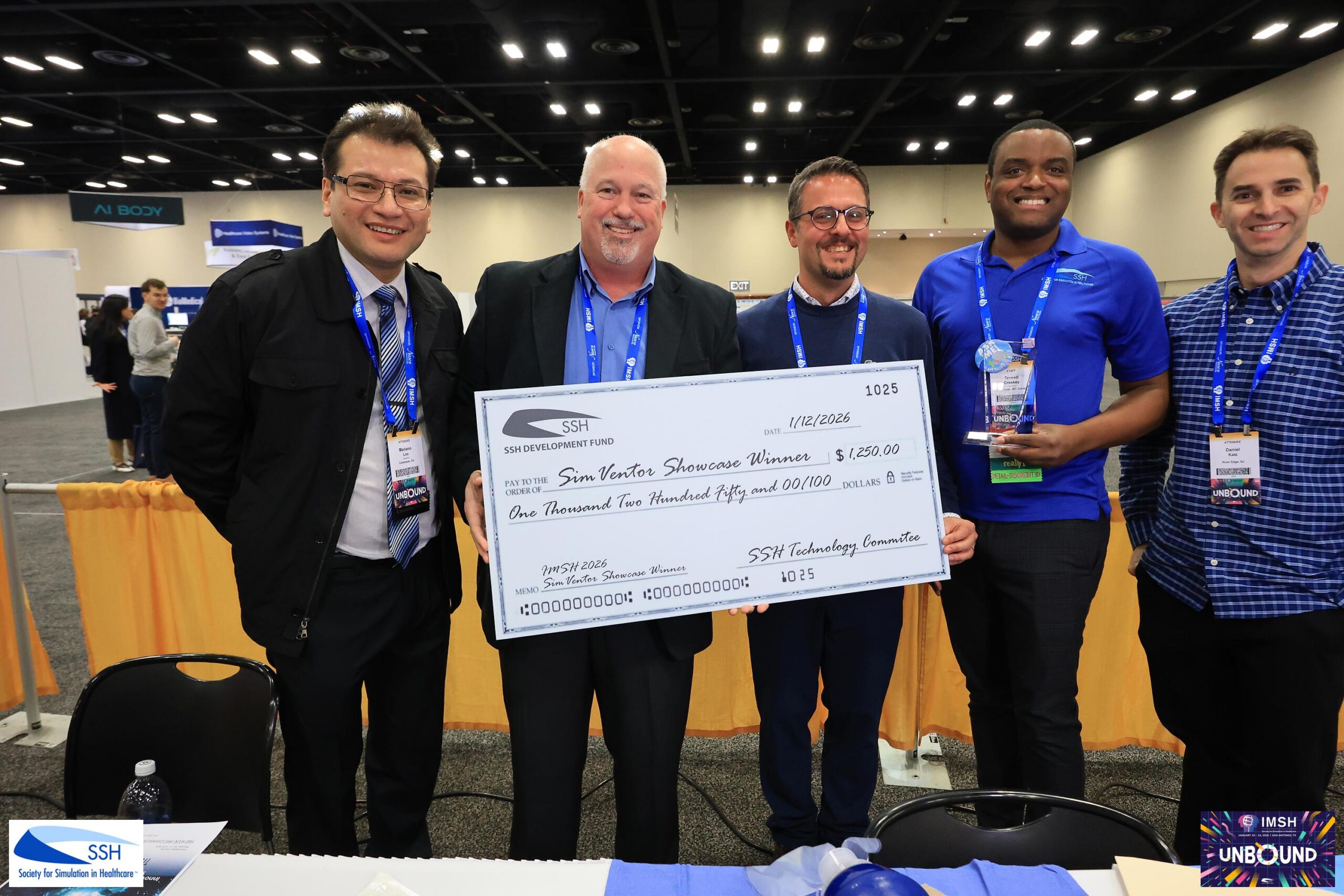
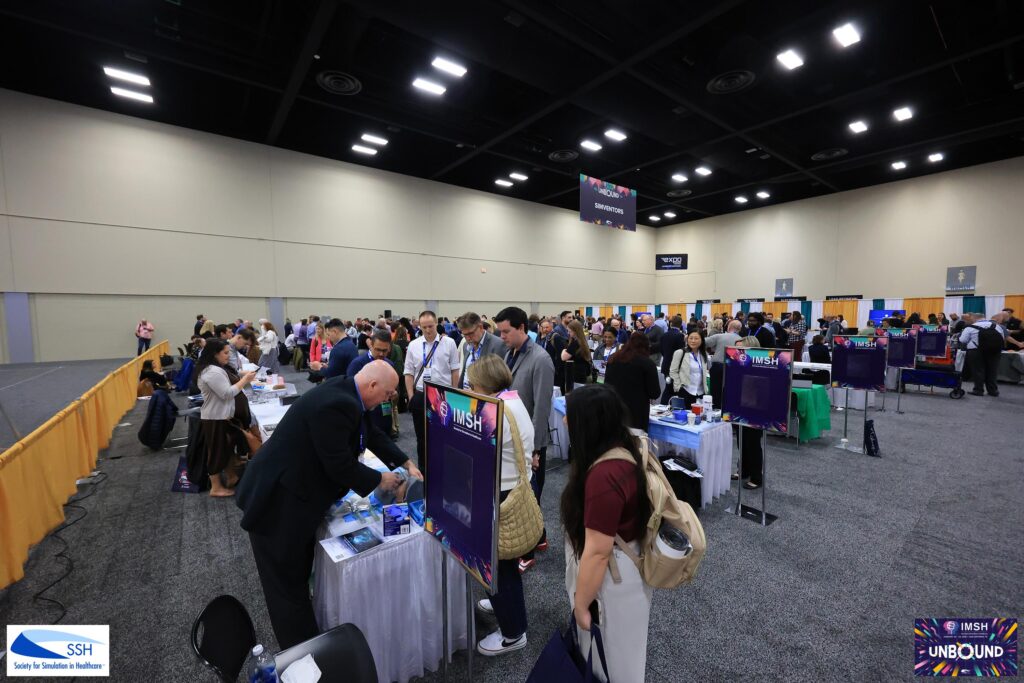
The tools received the Best Impact Award during the Society for Simulation in Healthcare’s International Meeting on Simulation in Healthcare (IMSH) in San Antonio in January. Dr. Acar, assistant professor and director of medical simulation at the School of Medicine, and Joe Slattery, assistant director of medical simulation for the School of Medicine, presented the project during the SimVentors Showcase.
“At IMHS, almost all the exhibitors agreed that all the models were realistic enough to train their trainees and students,” Dr. Acar said. “During the validation studies, we obtained feedback from Mercer-affiliated hospital residents. Mostly, they stated that the simulators are ready to go without major modification. We are having very positive feedback from many institutions.”
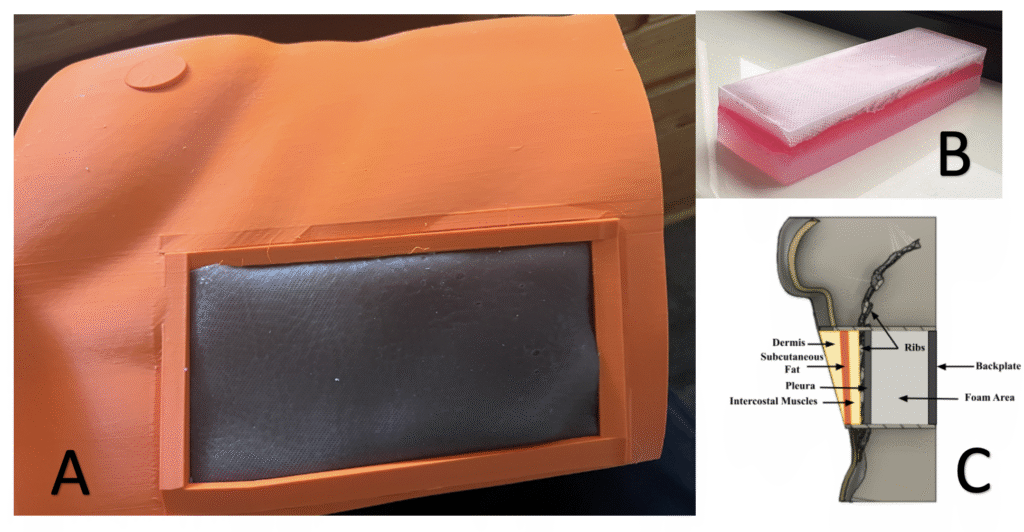
Chest tubes are inserted into the space around the lungs to remove air or fluid so the lungs can expand normally. Cricothyrotomy is an emergency procedure that creates a temporary airway by placing a tube through the front of the neck into the trachea so a person can breathe. Medical trainees need to practice these procedures multiple times to become proficient, but the high price of current simulation devices make them cost-prohibitive, said Dr. Robert Sarlay Jr., School of Medicine assistant professor and senior director of medical practice.
“Most simulators on the market are expensive and inaccessible for rural programs and institutions,” Dr. Acar said. “What makes our work different is we provide them from the ground up with accessibility, low-cost and reproduction in mind. Our goal was never to replace high-end simulations but bridge the gap between training or make it possible for rural or limited resource departments.”
Mercer’s biomedical engineering department contributed to the development of the 3D-printed devices. Dr. Joanna Thomas, associate professor and chair of biomedical engineering, and students in her 3D printing and FDA regulations elective course helped to identify feasible designs and build the cricothyrotomy simulator. They generated 3D scans, selected materials and fabricated the components of the prototype with 3D printers for usability testing, she said.
In addition, three biomedical engineering students — Priya Patel, Oladipo Sonuga and Meshwa Patel — worked on the chest tube simulator for their senior design project, under the guidance of Dr. Thomas and Dr. Acar. The team developed the design, fabrication and assembly of the 3D-printed prototype.
“Dr. Acar and Dr. Sarlay brought it to us as a really great initiative because they’re addressing a significant need for training practitioners,” Dr. Thomas said. “Giving them the opportunity to participate in realistic training more frequently is going to help everyone in terms of patient care and keeping them up-to-date on their skills.”
Following additional modifications by Dr. Thomas, the training devices were tested by Memorial Health University Medical Center surgery residents and attending physicians in the simulation lab on Mercer’s medical campus in Savannah, Slattery said.
“This is a low-cost alternative for the people who work for Mercer Medicine and around Georgia. We can send these trainers to them for pennies on the dollar for what it would cost to get commercial trainers,” Slattery said. “They can train at their facilities. This is the perfect example of what we could do to help the entire (School of Medicine) mission.”
The simulation devices are being used at Mercer’s Savannah and Valdosta campuses. Additionally, the University of Florida’s Center for Safety, Simulation & Advanced Learning Technologies in the Department of Anesthesiology, where Dr. Acar previously worked, requested permission to use the designs in its courses and recommended slight modifications to enable advanced ultrasound-guided cricothyrotomy procedures, Dr. Acar said.
The plan is to eventually share the 3D-printing files so that any facility, institution or simulation lab with a 3D printer can create their own simulation devices.
For instance, a paramedic group in a rural area with limited resources could print these devices to have better training resources for its volunteers, Dr. Sarlay said.
“This is just the beginning,” Slattery said. “We’ve already been approved to purchase 3D printers on all of our (medical) campuses. This shows the value, the added benefit, and it really is just the first step.”
3D printing the devices also allows for more flexibility and adaptability, Dr. Sarlay said. When a training device becomes worn, the facility or institution can print another one instead of having to place a costly purchasing order. Dr. Acar said he has already been in conversations with a few organizations that are interested in implementing the models into their training for medical personnel, and smaller models may be developed for pediatric training.
“That (IMSH) award has given the project great visibility and momentum,” Dr. Acar said. “We were already planning to move forward with a couple of ideas. Now we are encouraged to work harder and move faster to meet that demand. The project ultimately aims to build a sustainable ecosystem for (medical) simulation, and that meets the Mercer mission to improve the health care training in rural Georgia.”
Dr. Thomas said it was a great project for her engineering students to be involved in because it showed them how technological advances can be used to improve the design and functionality of products.
“Engineers are not only supposed to be designing new and great stuff. Sometimes engineering is about finding the best and most economical and efficient way to build things,” said Dr. Thomas, who is continuing to make modifications to the simulators as needed. “There’s a significant need for (these devices) in terms of training medical practitioners, but not at the (current) price point. So how can we help them address that need through considering new methods of fabrication and minimizing but not losing the components that help the trainees learn key skills?”
Mercer first-year medical student Anna Fe Miller, who earned her bachelor’s and master’s degrees in biomedical engineering at Mercer in 2024 and 2025, said she was introduced to the intricacies of 3D printing while working on the cricothyrotomy simulator with Dr. Thomas in spring 2024. The project also taught her about budgeting, teamwork and neck anatomy, and was a stepping stone to her master’s degree project, which involved creating 3D bone models.
Madison Kelly, a third-year medical student, has worked on this project with Dr. Acar since summer 2024, and two additional medical students contributed to the project this past summer as part of the School of Medicine’s Summer Scholars program. Kelly said she conducted background research on the related medical procedures, medical simulation devices and costs, and has been involved in product testing and evaluation since then.
“We’re still continuing to update and work on the simulation to make it the best it can be,” Kelly said. “Getting the opportunity to work with the engineering school not only taught me about that side of things but also the importance of interpersonal communication with others. I also got to see, hands-on, just how important simulation-based training is. There is a growing need for simulation-based training, and it’s not easily accessible. (This project) has shown me that with innovation and dedication, you can accomplish huge things.”