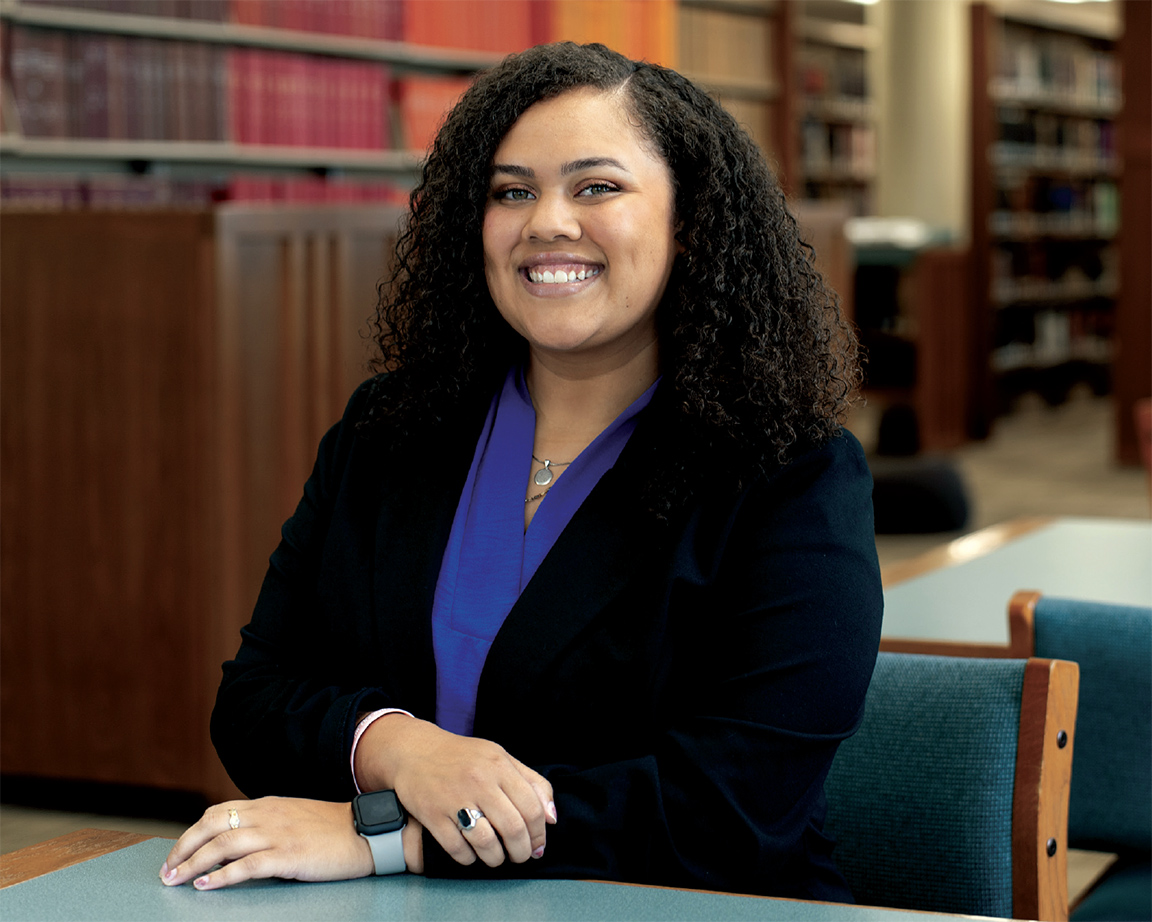
When George Floyd was murdered in May 2020, the world stood still, and for Kennedy Wright, LAW ’26, it was the moment everything changed.
“That moment awakened something in me. I couldn’t stand by and do nothing in the face of such blatant injustice,” said Wright. “I wanted to be a voice for those who often feel unheard and to challenge the systems that perpetuate inequality.”
That voice — clear, driven and full of conviction — is now finding its place in the legal profession, where Wright is preparing to practice civil rights law. Her journey, shaped by personal experiences and a deep sense of justice, is a powerful example of how purpose can be born from pain.
At Presbyterian College, Wright’s activism took early root. A finalist for the Harry S. Truman Scholarship, she also helped draft the college’s first anti-racism policy, now part of the official student handbook. She served as student body president and led the Multicultural Student Union, an experience she credits with deepening her understanding of advocacy and the power of policy.
Her service continued with AmeriCorps, working at a day shelter for unhoused young adults.
“That year taught me that as a lawyer, compassion and empathy must guide every interaction,” she said. “I realized the only thing separating any of us from homelessness could be one lost job or one missed paycheck.”
That human-centered philosophy continues in her work with the Georgia Legal Services Program, where she supports low-income clients through housing instability and legal challenges.
“When someone is in crisis, they’re in survival mode. You have to address the immediate need before you can help build long-term solutions,” she said.
Ask Wright what it means to be a civil rights advocate today and her answer is immediate: courage.
“Being an advocate is having the courage to stand up for what is right, even when it is uncomfortable or unpopular,” she said. “It’s about holding systems and institutions accountable, especially when they fail the communities they claim to serve.”
On campus, Wright serves as vice president of the Black Law Students Association and as a Barbri representative, ensuring students have the support they need to prepare for the bar exam.
She’s also participating in the Civics Field Placement program and completing an independent study on police practices — projects that reflect her commitment to civil rights and justice reform.
Law school isn’t easy, but Wright said she’s made it through with help from a strong support system — friends, faculty and family who encouraged her every step of the way.
“I found a tight-knit group of friends who formed a study group where we held each other accountable and made sure no one was left behind,” she said. The Black Law Students Association also played a major role. “They made sure that first-year students knew we had a village behind us.”
When things got overwhelming, she leaned on her family and her partner, Joshua, for support. One of her most impactful academic influences has been Associate Dean and Professor Pam Wilkins.
“After just one class, I remember thinking, ‘I’m going to take every course this professor offers,’” Wright said. “Her passion for teaching is matched only by her genuine investment in her students.”
Wright’s future is clear: she plans to practice civil rights law in the South, specifically Georgia or her home state, South Carolina.
“This region holds deep personal meaning for me. I’ve lived, served and studied here, and I’ve seen firsthand the unique challenges Black and underserved communities face,” she said.
She sees herself as part of a new generation of Southern advocates, those who are reimagining justice not just through the courts but through education, trust-building and community presence.
“I didn’t come to law school just to earn a degree; I came to make a difference,” Wright said. “Mercer’s commitment to ethics, service and practical training align with the kind of lawyer I want to be: one who serves people.”
Her vision includes advocating for victims of police violence, pushing for transparency in law enforcement, and dismantling systemic racism in the criminal justice system. But her mission goes beyond litigation. She wants to empower communities and restore trust in a legal system that has too often failed them.
“Passion is powerful,” she said. “But purpose is built moment by moment, relationship by relationship. You don’t need to have everything figured out to make an impact.”
To others on their own path toward justice, Wright offered this advice: “Don’t shrink yourself. Your lived experiences, your voice matters. The world doesn’t just need more professionals. It needs more people who lead with heart, with integrity, and with the courage to challenge injustice head-on.
“Be bold. Be relentless. And remember — every step you take toward justice, no matter how small, is part of a legacy far bigger than you.”