Mercer University gave Bob Washington the educational experience he needed to begin his next chapter after he retired from the U.S. Navy.
Now a senior research engineer at the University of Dayton Research Institute in Warner Robins, he creates repair technologies that extend the life of U.S. Air Force aircraft. This summer, he’s also mentoring a Mercer engineering student.
After high school, Washington immediately went into the Navy and served for a decade, mainly in the Asia-Pacific region. After retiring, he set his sights on becoming an engineer.
“I always wanted to build things, and I liked engineering, so that’s what I wanted to do with the rest of my life,” he said.
He enrolled at Georgia Institute of Technology at age 30 and quickly felt in over his head in his first class, calculus. After struggling for a year and a half, he decided to redirect his energy.
“I took a deep breath, kicked my ego to the side and decided to go to a junior college and brush up on my math skills,” he said. “Then I went to Mercer from the junior college. I didn’t want to go back to Georgia Tech. I looked at the class sizes of Mercer, and to me, that felt better.”
He completed his engineering degree in 2012 at age 45. Washington said he received a well-rounded education at Mercer.
“I think the senior project did the most to prepare me for when I went out into the actual engineering world,” he said. “I had gone through the PDR (Preliminary Design Review), the CDR (Critical Design Review), that development process. You take what you learn, and you apply it, but it’s a structured application of it. When I got into the real world, what I was doing made sense to me.”
Washington began his engineering career at niche engineering firm ES3, where for six years he was involved in the research and development of technologies to repair, restore and improve metal parts and to enhance manufacturing and finishing processes. In 2019, he transferred those skills to the University of Dayton Research Institute in Warner Robins, where he became the team lead of additive repair technologies.
The Research Institute runs the Advanced Technology and Training Center for the Air Force with facilities in Dayton and Warner Robins, where its focus is sustainment technology using additive manufacturing and repair — or the production or repair of objects by adding material, including through 3D printing. Washington’s team adapts metal repair technologies, so they can be used to sustain readiness of the Air Force.
“For most of (the jobs), we’re just extending the life of the part because once it gets out of tolerance, they have to discard it and they don’t have a replacement for it,” he said. “What we’re doing is finding a way to repair it and put it back into service. It saves them a lot of money, and it saves them a lot of time. We’re able to give them a means for keeping that aircraft in the air and keeping those parts usable.”
Some aircraft parts can require months to years to repair, but these new technologies can reduce repair time and aircraft downtime substantially. For instance, one particular aircraft repair took 200 man-hours just to remove the part from the aircraft and reinstall it. Washington’s team developed new technology that allowed the repair to be completed on the aircraft and cut the job time to two to three hours.
“It’s always something different, so it’s interesting,” Washington said of his work. “They throw new technology at you and say, ‘Hey, figure this out.’ It’s really nice. You see what it can do. There’s always challenges to it. It never goes perfect.”
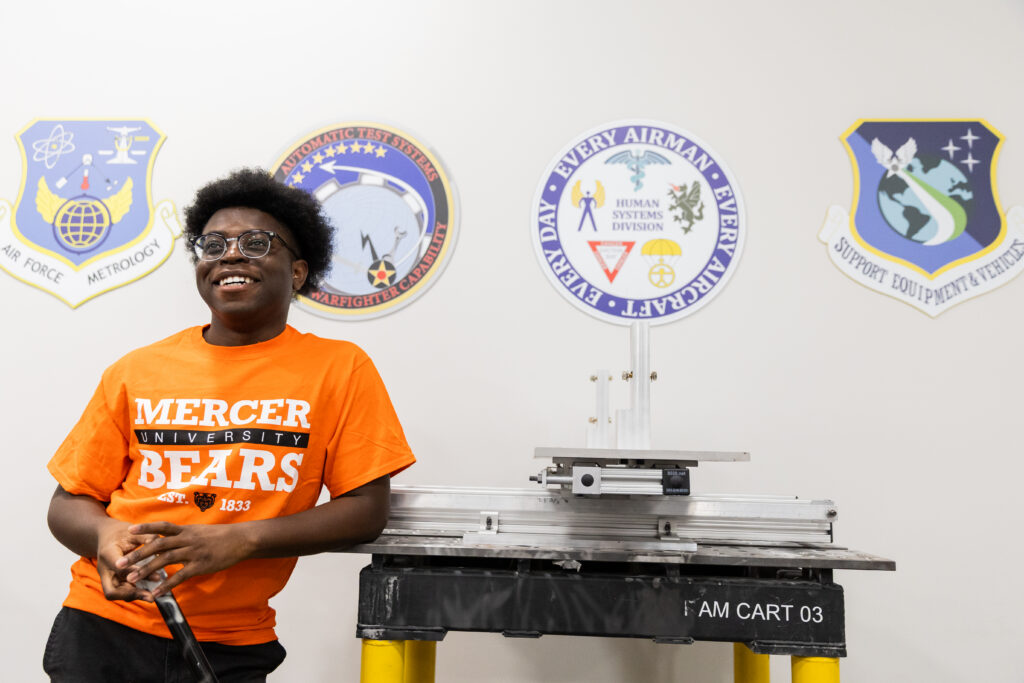
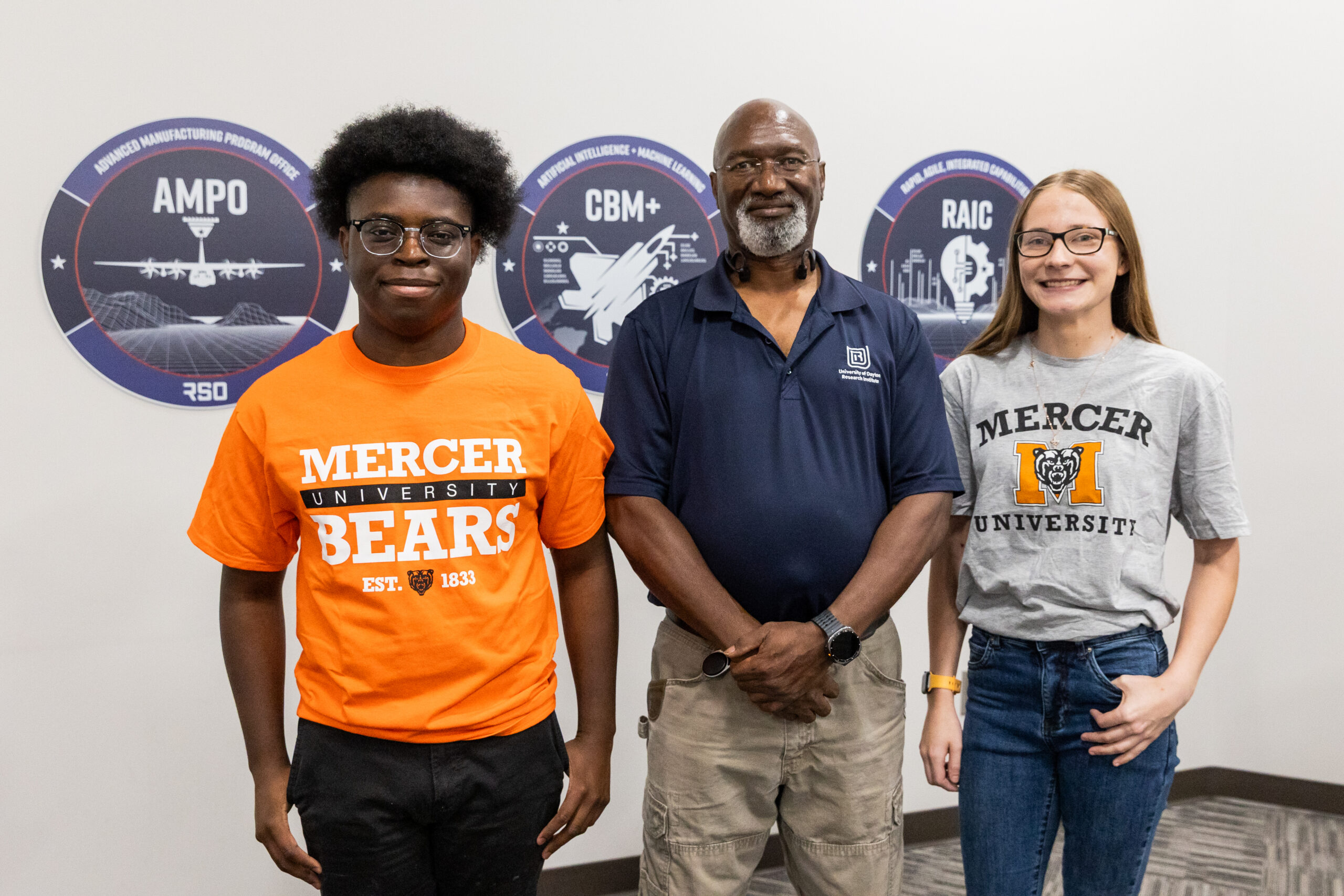
This summer, Washington is mentoring Mercer student Darrell Yankey, EGR ’27. Another Mercer student, Amy Pagenkopf, EGR ’29, is interning with the Research Institute’s additive manufacturing team.
“This year, we made it a focus to go live and recruit interns and to get more involved in STEM (science, technology, engineering and math) and education,” Washington said. “The way our site is doing it, we’re exposing them to all the different areas of our facility. They’re learning all the different teams and what they do. … We want to continue doing (internships), and we want to expand on it.”
Yankey, a mechanical engineering major, was hoping for a summer internship that involved research, design, and repair and manufacturing of mechanical systems. The Research Institute opportunity, which he saw listed on Mercer’s career networking platform, Handshake, met all of his criteria.
This summer, Yankey has been tasked with redesigning a fixture to help stabilize machine parts as they’re being repaired. He presented three preliminary ideas to Washington and his team and is now working on the selected option.
“He came up with some very interesting designs,” Washington said. “The one that was selected was one I would have never thought of.”
Yankey said he has learned how extensive the process is to get a design ready for manufacturing. He’s gaining exposure to new engineering aspects and systems. As his internship continues, he hopes to learn about the engineers’ career journeys to help him decide on his post-graduation plans.
“I’ve been asking a ton of questions. I think I’ve come pretty far along in (my project),” Yankey said. “I like working under (Washington). I can go and figure things out while also having his help, so I’m not totally on my own. He’s letting me learn things like I would in the field of engineering.”
Washington has enjoyed getting to share his knowledge with Yankey.
“We’ve gotten away from that a lot, because people try to hoard their knowledge to hold onto jobs. I think we’re doing a disservice to our younger generation by doing that. We lose a lot of skills because of it. I think passing it on is a great idea,” Washington said.