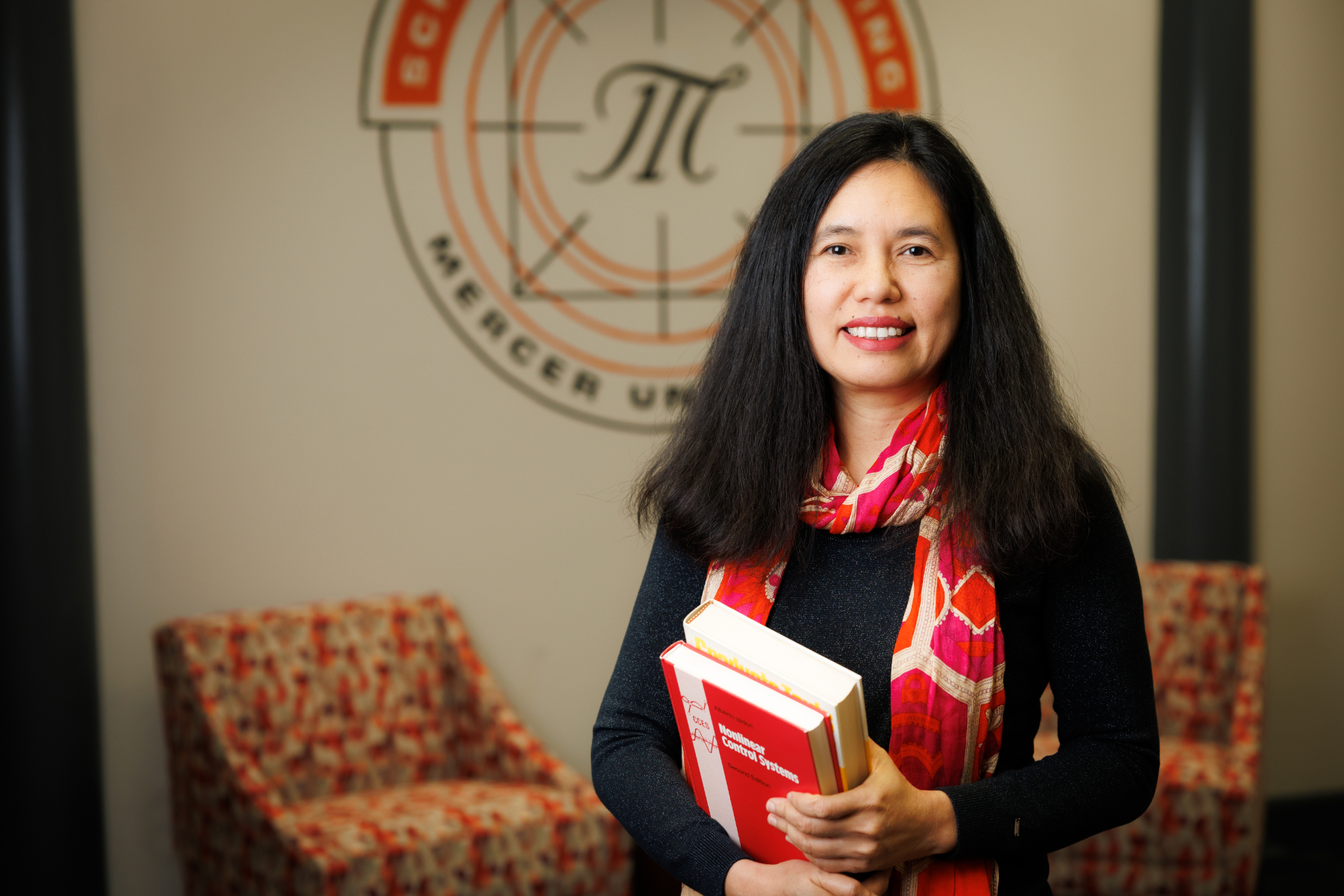
As a professor of electrical and computer engineering at Mercer University, Dr. Makhin Thitsa accelerates progress in her field while opening doors for students to engage in mentorship that shapes their futures as engineers.
While growing up in Myanmar, she was often told subjects like math and engineering were meant for boys. When she first started studying engineering, she felt discouraged but worked hard to break that stereotype. In the process of proving that women were just as capable of engineering, Dr. Thitsa fell in love with mathematics.
“Talent helps, opportunity helps, but hard work is what carries you through. There is no substitute for hard work. But hard work only sustains you if you believe it will matter,” she said. “You have to believe that your effort can change the outcome. That you can learn and grow.”
After receiving her bachelor’s degree in electrical engineering from Old Dominion University in 2005, she pursued her master’s in electrical engineering, completing her degree in 2008. In 2011, she earned her Ph.D. in electrical and computer engineering. She then taught and conducted research at Old Dominion for two years before joining the Mercer School of Engineering as an assistant professor in 2013. Dr. Thitsa also is a research affiliate at the Massachusetts Institute of Technology.
“My work involves developing and applying mathematical tools to design and analyze control systems, and importantly, to prove mathematical guarantees about how they behave,” she said. “It’s deeply rooted in mathematical analysis.”
The research and work that she is most proud of is the Mandalay derivative, named in honor of her hometown, in an effort to recognize where she came from in her work.
Dr. Thitsa’s job at Mercer brings together teaching and research, her greatest passions. She said her research makes her a better teacher, as it forces her to deal with unfamiliar problems and struggle. This allows her to understand her students.
A large part of Dr. Thitsa’s understanding of students comes from her mentorship of undergraduate students. She specifically selects students who can manage research on top of the already tough workload for engineering students. She meets each of her research students for two to three hours a week to provide them a theoretical background often not included in undergraduate engineering.
Dr. Thitsa makes an effort to connect with her students individually and ensure they see their full potential. She strives to create a genuine connection by seeking interaction with them outside the classroom. Her mentorship differs based on the student. Some students’ mentorship is related to projects as a supervisor and others as an informal advisor.
When Dr. Thitsa meets students who she believes are being under-challenged during class, she makes an effort to help them achieve their goals. She also makes an effort to reach out to students in need of guidance and support, having learned that small gestures from faculty members can create a big difference in students.
“This kind of emotional connection is the reason they keep in touch with me on a regular basis, even after they have left Mercer,” she said. “Even several years after graduation from Mercer, they call or write to me when they have a new baby, bought their first house or got a job offer they are really excited about. These lifelong friendships I have developed with my students have given me more satisfaction and reward than any other accomplishments in my career ever could.”
In 2024, she was awarded the Mike MacCarthy Mentorship Award for her dedication to “enabling the dreams of others” through her mentorship of students. In 2023, she was nominated for the Council on Undergraduate Research Goldwater Faculty Mentorship Award for her mentorship of six Goldwater Scholars. Her research is supported by agencies, such as the Air Force Research Laboratory and the Georgia Department of Transportation.
Dr. Thitsa encourages future women leaders to work hard and make sure to put time toward taking care of themselves and finding joy.
“Confidence doesn’t always come first,” she said. Sometimes it grows from doing the work, but you must give yourself permission to try. So, believe in yourself.”