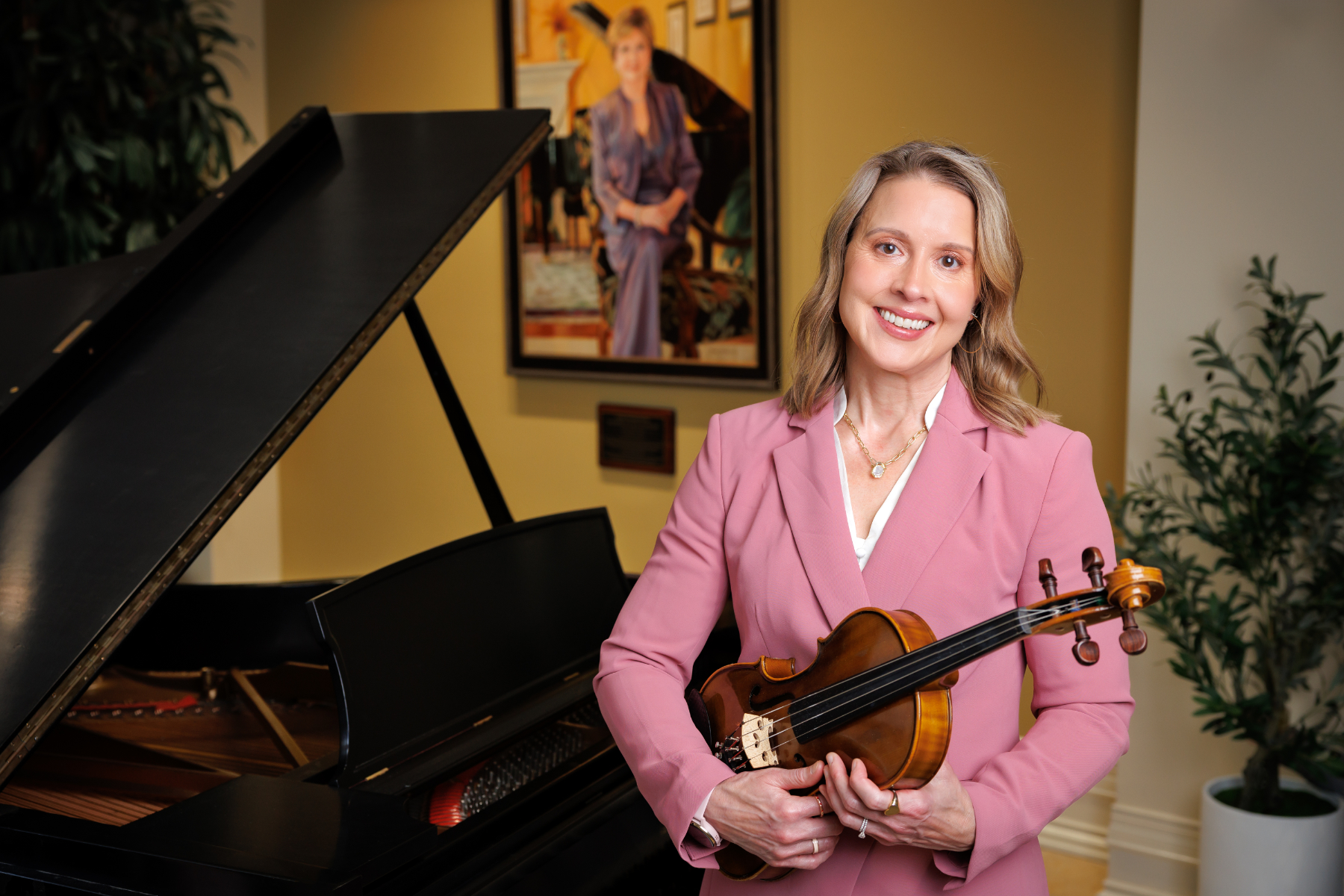
On any given day at Mercer University’s Townsend School of Music, a violin scales upward behind a practice room door. A jazz combo may be doing a last-minute check before a performance in Fickling Hall. A soprano hits a high note in a private lesson. For Dr. Katie Rios, that hum of constant creation is what sparks inspiration for her teaching and scholarly work.
“Townsend School of Music is a special place, and you feel that as soon as you step in the building,” she said. “Talent fills this space. You can hear it, see it and feel it.”
Dr. Rios, associate professor of music, believes that the energy of the building is hard to put into words.
“This is invigorating and inspiring,” she said. “This creative space extends into the classroom.”
Dr. Rios joined Mercer’s faculty in fall 2013, bringing with her scholarly depth and lived musical experience. A violist who has performed with orchestras including the Green Bay Symphony and the Fayetteville Symphony Orchestra, she is also a musicologist whose research explores musical borrowing, American vernacular traditions, hip-hop, ethnography and pedagogy. Her book “This Is America”: Race, Gender, and Politics in America’s Musical Landscape examines how music reflects and shapes the nation’s social and political currents.
But before she was publishing scholarship or presenting at national conferences, she was a middle school student who had questions about music and a teacher who took them seriously.
“When I think about some of my most important and meaningful musical inspirations, I immediately picture my middle school music teacher, Mary Hillyard,” Dr. Rios said.
Hillyard not only conducted the orchestra but also listened patiently as her young student consistently asked her more about private lessons, practice records and tuning — “just being a good musician,” Dr. Rios said.
A youth symphony conductor, John Varineau, reinforced those lessons, teaching Dr. Rios to listen “carefully, critically, patiently, attentively and joyfully.”
Listening has always been more than a technical skill for her. She traces some of that sensibility to summers at Interlochen Arts Camp, where music and nature intertwined.
“The trees, water and walking paths through the woods there were an integral part of my musical education,” she said.
That taught Dr. Rios to expand her awareness beyond the notes on the page. She often recalls composer Pauline Oliveros’ instruction: “Take a walk. Listen with your feet.”
Whether she is annotating program notes for the Atlanta Chamber Players or attending a student recital, “listening to and experiencing music,” she said, is the most rewarding part of her work. “I also treasure being a lifelong learner.”
Her path to musicology took shape at the University of Michigan, where she pursued a blended degree in musicology and viola performance with advanced seminars that mixed graduate and undergraduate students. She found a mentor in an unlikely place: a graduate student “study buddy” who answered questions about the field and demystified the next steps.
At the same time, Dr. Rios nurtured another lifelong love: reading and writing. One of her favorite gifts, she said, was a desk.
“My family laughs at me to this day that I rave about that gift,” she said.
But for her, that desk symbolized a place to be creative.
“Once I knew that I could pair my love of music with my passion for written words and expression, musicology was an appealing choice,” she said.
Dr. Rios’ scholarly interests reflect that synthesis of different ideas. She is particularly interested in the social and communal aspects of music-making, especially as it pertains to American politics. She is equally passionate about exploring music beyond the traditional canon, particularly new artists.
“I am fascinated by progressive artists such as Laurie Anderson. I love the origin story of hip-hop and the art of the genre. I love music and literature that challenges me to be a better person,” she said.
Dr. Rios loves when students stop by her office to discuss a new album or book.
“I want to hear about all of it,” she said.
Mapping how music circulates through culture, she acknowledges that focus can be a challenge in her work.
“I love to think about the big picture,” she said. “My challenge is that I do that with everything.”
Over time, she said, she’s learned to be more intentional about defining goals, audience and time constraints, “whether the project is a 50-minute lecture, a 20-minute conference presentation, a 10,000-word article or a 50,000-plus-word book.” She’s practicing giving herself permission to step away from a project when necessary, allowing ideas to breathe.
Asked what advice she would offer future women leaders, Dr. Rios pointed Mercerians to the present: “Take a moment to reflect upon and celebrate the historic election of our University’s first female president, Dr. Penny L. Elkins,” she said. She urged future leaders to seek out women-centered resources and more broadly, encouraged women to trust their intuition, ask questions, embrace curiosity and learn openly from mistakes. Just as importantly, she emphasized well-being: mental, physical, emotional and financial.
At Townsend, she finds daily reinforcement for that philosophy.
“I am grateful for the daily, round-the-clock support of students, colleagues and staff,” she said.
Step into McCorkle Music Building, and you’ll hear melody taking shape. For Dr. Rios, these moments are an invitation to listen more deeply and to remain open to the next sound.