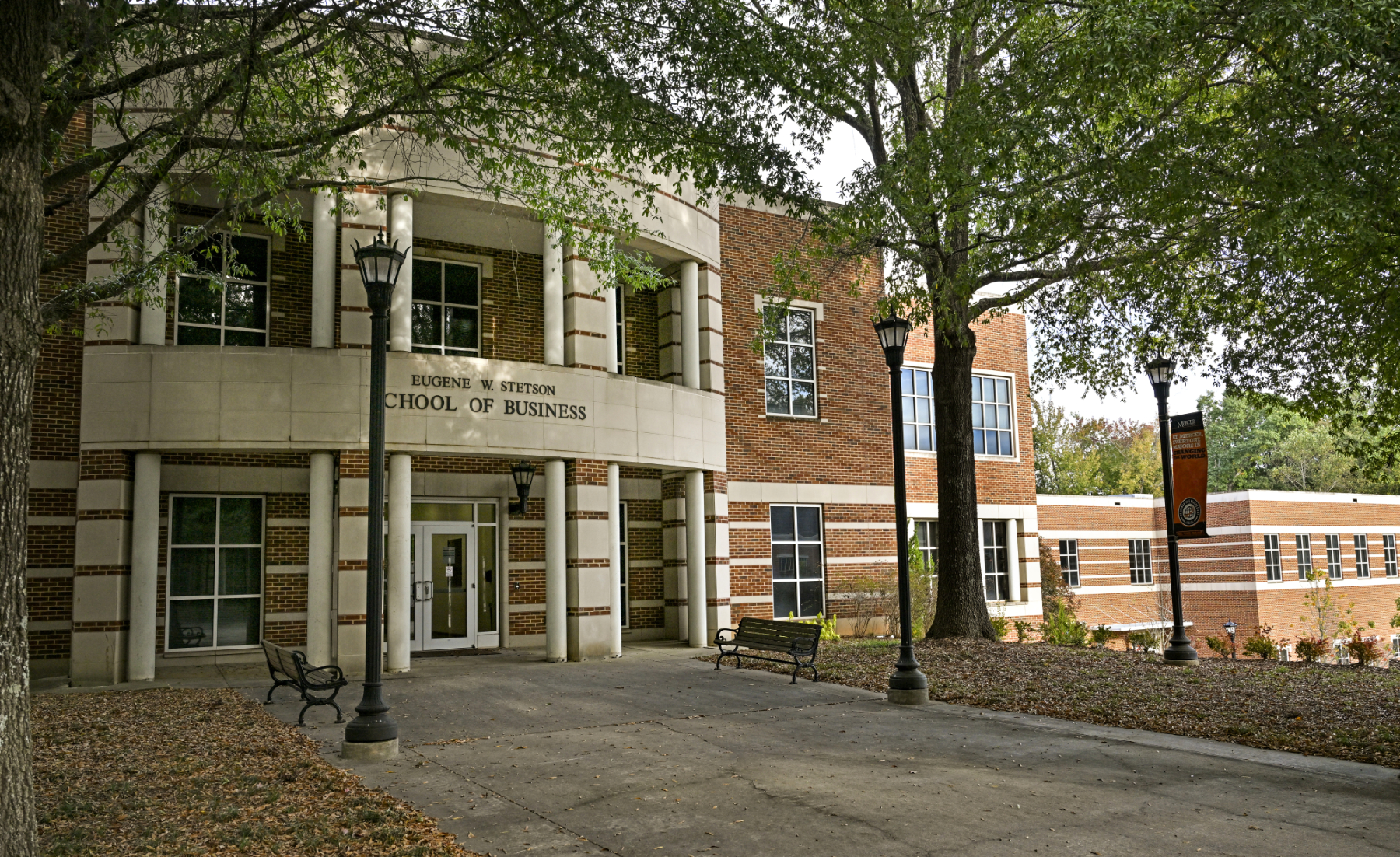
Editor’s note: This story was written by Clara Kurczak, a freshman majoring in journalism.
Sixteen Mercer University students competed in the 11th annual Virtual Elevator Pitch Competition, which was sponsored by the Mercer Innovation Center and Sigma Nu Tau, the entrepreneurship honors society. The event took place over a Zoom call on Nov. 5.
The competition invited students from all campuses, schools and majors to deliver two-minute pitches for their original business ideas. The students then received immediate feedback from three judges.
School of Business Dean Dr. Julie Petherbridge opened the evening by commending participants for taking part to gain experience.
“Pitching never goes away,” she said. “The more comfortable you are and the more concise, the more skill set you gain from doing this.”
After nearly two hours of student pitches and judge deliberation, the judges decided to name four winners, marking the first four-way tie in the competition’s history.
“It was one of the strongest groups we’ve had in a really long time,” Dr. Petherbridge said. “I was impressed with all of the presentations and thrilled that so many people came out to compete.”
The four winners were:
- Richa Tyagi, a pharmaceutical sciences Ph.D. candidate, with Frigilix, a drug designed to target neural circuits affected by Fragile X syndrome to reduce symptoms where current treatments fall short
- Mya Morgan, a student in the Master of Science in clinical mental health counseling program, with Mynd, pronounced like “mend,” an app that helps users understand therapy approaches in everyday language and connects them with licensed therapists
- Habtamu McLain, a senior double-majoring in marketing and entrepreneurship, with Sole Pad, a smart alarm clock mat that requires users to physically stand up to turn it off
- Timothy Johnson, a student in the Master of Science in integrative business program, with SaveUp, a financial wellness app that combines artificial intelligence tools with human coaching to build sustainable money habits
Each winner received an equal share of the prize pot, which was increased from $750 to $1,000.
Other business ventures presented included a legal mobile bus, modular napping pods, flexible wound tape and nutrition apps.
Dr. Marko Horn, associate professor of management and entrepreneurship and the competition’s host, said his favorite part of the competition was witnessing the students’ creativity.
“To see all these wonderful ideas, a lot of times, they’re something not in my wildest dreams,” Dr. Horn said.
The competition concluded with encouragement for students to use the feedback they received from judges to continue developing their ideas for Mercer’s Next Big Idea Competition, an in-person pitch event hosted in the spring.