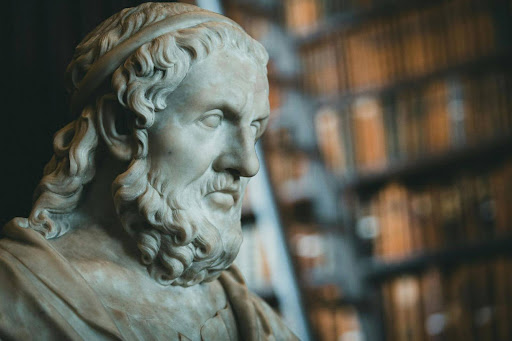
MACON, Ga. — Mercer University’sThomas C. and Ramona E. McDonald Center for America’s Founding Principles will host its 13th A.V. Elliott Conference on Great Books and Ideas, focusing on the theme “On Homer and Political Philosophy,” on April 13-14 on the Macon campus.
Dr. Will R. Jordan, co-director of the McDonald Center for America’s Founding Principles and professor of political science, said they were excited to be able to bring to campus some of the nation’s very best scholars of Homer.
“In the McDonald Center faculty-student reading groups this academic year, we read both the Iliad and the Odyssey in preparation for this event. It is a wonderful experience for our students to see what can be gleaned from a text, even a text thousands of years old, if we read and reread it carefully. Students also come to see that many of the subjects that Homer brings to light are no less urgent and vital to us than they were to Homer’s original audience.”
This year’s conference includes lectures and panel discussions from 11 scholars from across the country. Additionally, nine Mercer students will be presenting their research.
The conference is free and open to the public.
Schedule:
April 13
Student Panel
4 p.m., the Mercer Innovation Center
Opening Lecture
6 p.m., the Mercer Innovation Center
Jenny Strauss Clay, classics, University of Virginia
“Zeus’s Politics in the Iliad”
April 14
Morning Faculty Panel
9 a.m., the Mercer Innovation Center
Douglas Frame, Hellenic studies, Harvard University
“Homer on Leadership”
Andrew Gross, political science, Clemson University
“Homer’s Inquiry into Politics: On Achilles and the Achaeans in Books 1 through 9 of the Iliad”
Michael McShane, philosophy, University of Texas at Arlington
“Penelope Descends. The Odyssey Begins.”
Morning Lecture (delivered remotely)
10:45 a.m., the Mercer Innovation Center
Gregory Nagy, classics, Harvard University
“Toward a Homeric conclusion: Thoughts about Athena as a model for Leadership in Odyssey
xxiv”
Second Student Panel
1:25 p.m., the Mercer Innovation Center
Second Faculty Panel
2:30 p.m., the Mercer Innovation Center
Seemee Ali, humanities and culture, Southern Methodist University
“Eros and Noos in the Iliad”
Maxwell Anthony, doctoral student, Teachers College, Columbia University
“Phoenix as Educator”
Leonard Muellner, classical studies, Brandeis University
“Formulaic and Narrative Multiforms in Homer”
Closing Faculty Panel
4:15 p.m., the Mercer Innovation Center
Glenn Arbery, humanities, Wyoming Catholic College
“Father Zeus and the Armor of Peleus”
Mark Kremer, politics, Hillsdale College
“Domestic Disappointment and Homer’s Phaeacians”
John Moss, classics, University of Dallas
“Caveman: Homer’s Cyclops”
The McDonald Center for America’s Founding Principles has held an annual Conference on Great Books and Ideas since 2008. That conference was endowed with a $1 million gift from alumnus and trustee A.V. Elliott in November 2012. Elliott, a 1956 graduate of the College of Liberal Arts and Sciences who majored in history and Christianity, went on to found Elliott Machine Shop, a 100-employee company in Macon. His success, he said, was in part due to his ability to think critically at important moments, a skill he honed in his humanities courses at Mercer.
About the Thomas C. and Ramona E. McDonald Center for America’s Founding Principles
The Thomas C. and Ramona E. McDonald Center for America’s Founding Principles exists to supplement Mercer University’s excellent liberal arts program with a redoubled commitment to the foundational texts and ideas that have shaped Western civilization and the American political order. This focus on the core texts of the Western tradition helps to revitalize a cross-centuries dialogue about citizenship, human rights, and political, economic and religious freedom, thereby deepening the moral imagination and fostering civic and cultural literacy.
The McDonald Center’s programming includes the annual A.V. Elliott Conference on Great Books and Ideas, faculty-student reading groups, a general education course on America’s Founding Principles, summer Great Books programs for high school teachers and students, and undergraduate research fellowships. All programming is designed to enhance Mercer’s long-standing role as a distinctive home of liberal learning, a place where serious students come to live the life of the mind and emerge more thoughtful and engaged citizens.