My mother is a mostly self-taught artist. She is particularly fond of the 17th-century Dutch painter, Rembrandt van Rijn, and often paints her own version of his masterpieces. Hanging on the wall next to my desk are two of her Rembrandt “copies.” Both are biblical scenes, Christ in the Storm on the Sea of Galilee (1633) and The Supper at Emmaus (1648). To my untrained and biased eye, they look remarkably similar to the originals. She has painted many other subjects as well, including beautiful portraits of her four grandchildren.
It has been more than 30 years since her last painting. And, at age 94 with plenty of time on her hands, I wanted to give her a new challenge … sketching. The timing is perfect. She now has four great-grandchildren, all waiting for their portraits to be done too.
So, in my not too subtle way of urging, I bought her some sketching pencils for Christmas, hoping she would jump at the opportunity. Hesitatingly, however, she explained to me that she hadn’t painted in quite some time and wasn’t sure if she could still do it. And, she had never done sketching before. On top of all that, she needed an angled drawing table … which she did not have.
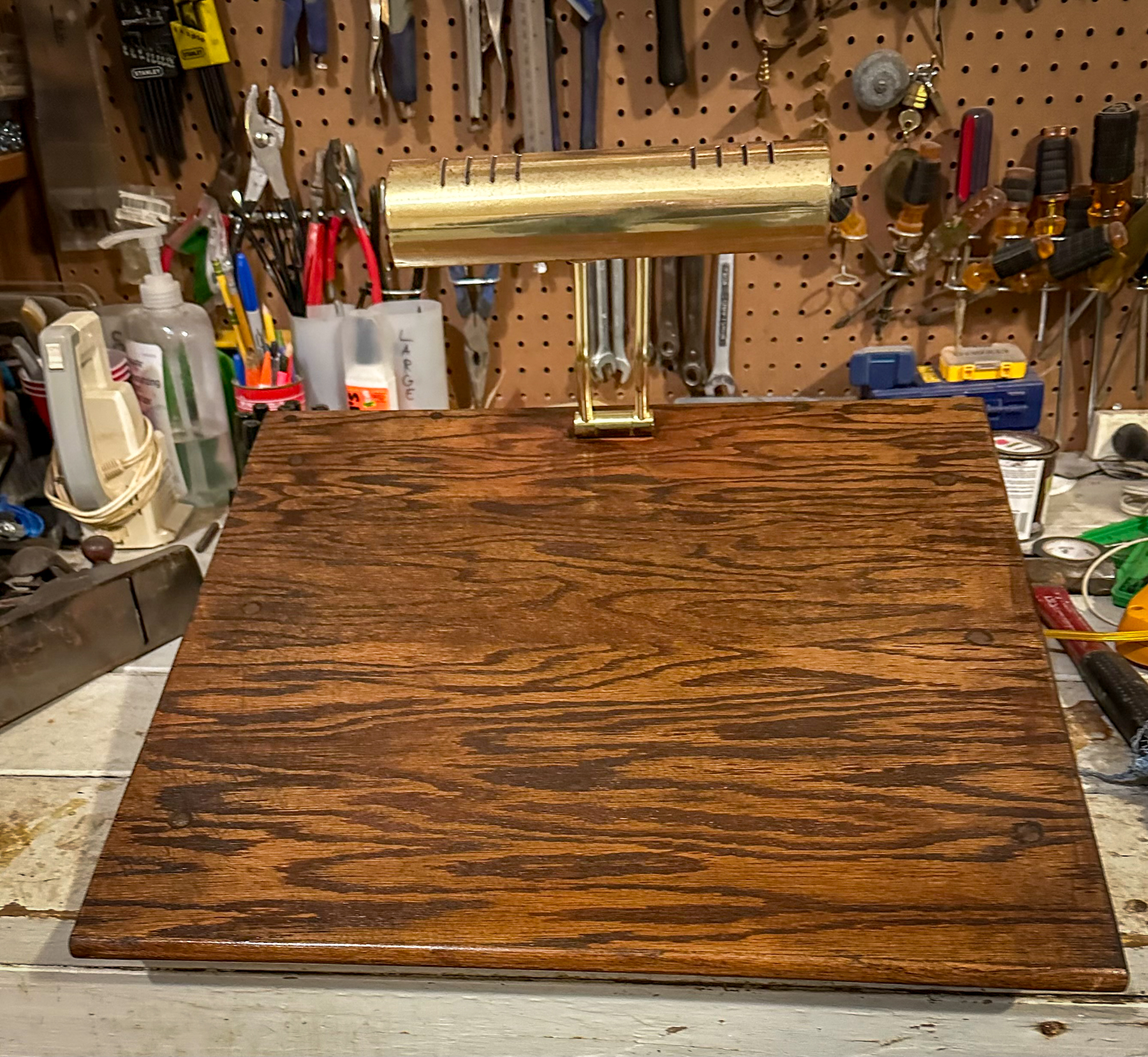
If she was trying to put me off, it didn’t work. I assured her she could still do it, and I promised that I would make her a desk. A tabletop drawing desk should be a pretty simple project. A smooth, square drawing surface. Two side pieces cut in the shape of isosceles triangles to give it a proper tilt. And a back. Easy-peasy.
I didn’t want to buy large planks of wood from the lumber store for such a small project. So, I began to sort through scraps of wood that I had left over from other projects. I found a piece of cherry wood that turned out to be the perfect size for the desktop. Then I found an old board from a project I had abandoned that was just the right size and length for the triangular sides. A leftover piece from a different project would do nicely for the back. And, I had a banker’s lamp with a broken base that I was pretty sure I could fit onto the desktop.
I sawed the pieces to the proper size, sanded them smooth, and screwed and glued them together. Next, I found a new inner tube for a bicycle we no longer had and cut it to fit on the bottom of the desk so that it wouldn’t slide or make scratches. I re-wired the banker’s light and attached it to the upper end of the drawing surface. When it was finally all assembled, I added a couple of coats of stain and sealer to give it a uniform finish.
During the process of building this small drawing table, I kept being reminded that the leftover scraps, the abandoned projects, and broken things can still be valuable for making something useful, something good … even beautiful.
As I start into my seventh decade of life, I can see so many times the plans that didn’t work out, the failures that landed on the “scrap pile,” the random pieces of life that didn’t seem to fit and so many other ruined things that all ended up being just what I needed. My missteps and mistakes taught me priceless lessons. My failures closed some doors but opened others to a whole new world. The efforts that seemed like wasted time turned out to be preparation for something surprisingly wonderful. And, even the things that were broken could be put back together … maybe not exactly as they were but still useful and good.
As time goes on, I am learning to be more hopeful when things don’t turn out as I had planned. I am learning to be more patient, waiting for the gift that may come out of something lost. I am learning to be more trusting that my life is in bigger hands, shaping and collecting the scraps and culling them into something nice. I am learning to be patient with myself as tarnish eventually turns into patina. I am learning that — even though it may take some time — everything, the so-called good and the so-called bad, can be woven together into a beautiful tapestry that becomes our life.