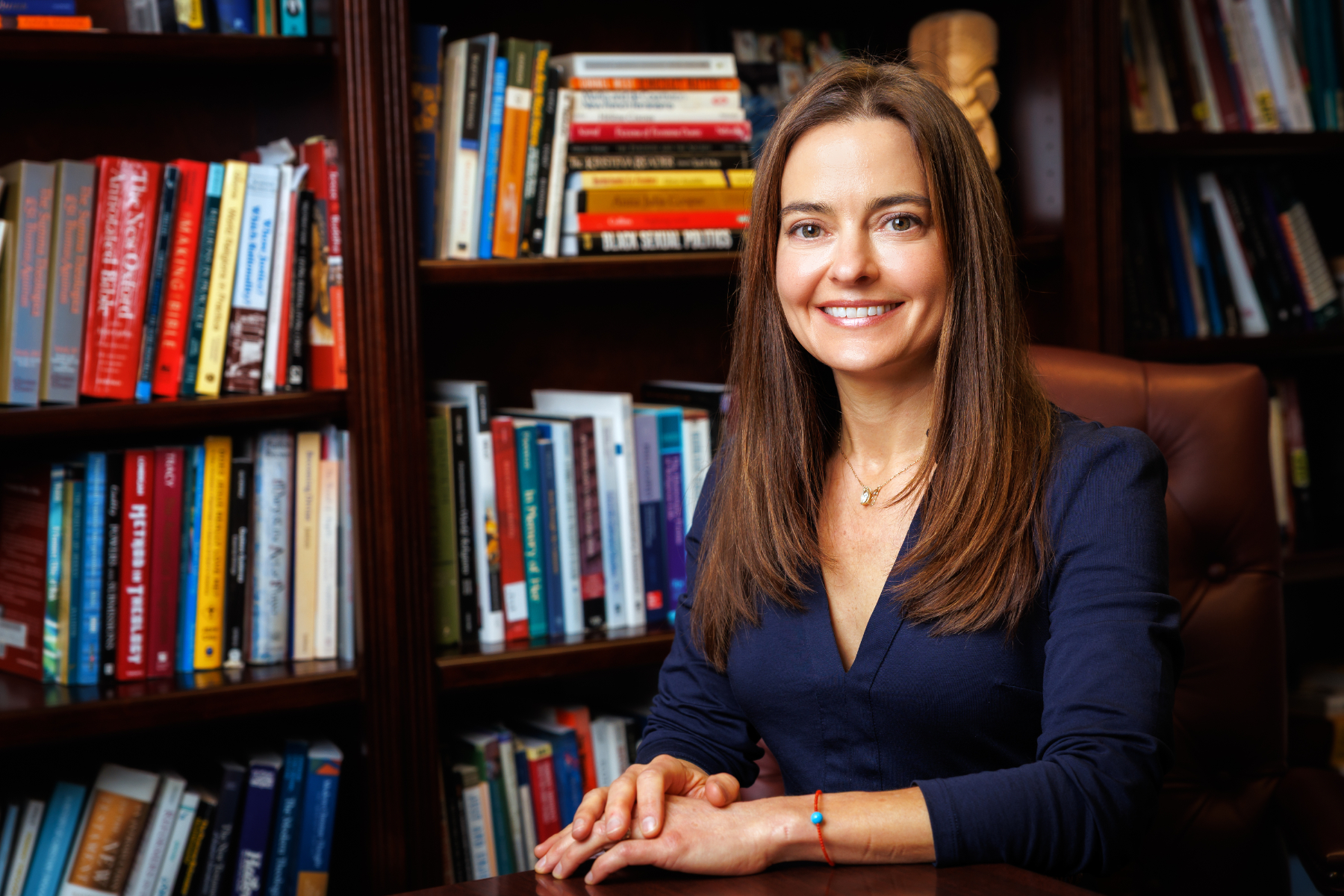
Mercer University Associate Professor Dr. Wesley Barker believes providing students and faculty with meaningful human connection helps them do their best work. That’s why as department chair she’s spent time creating spaces that support authentic engagement.
“In an age where technology is not only mediating human-to-human interaction but actually substituting for it, finding meaningful human connection seems to be really challenging,” said Dr. Barker, chair of the liberal studies department in the College of Professional Advancement. “At the same time, that challenge for me is almost like an ethical demand.”
Many students in the College of Professional Advancement are post-traditional learners who take classes online, with faculty spread across several campuses. Through a variety of innovations, Dr. Barker brings students and faculty closer to Mercer and to each other.
Under her leadership, the Department of Liberal Studies has created a student-focused liberal studies newsletter, a student-led liberal studies virtual showcase focused on student and faculty scholarship, and an active student honor society. These efforts, along with offering accessible study abroad opportunities, engage students in learning, expand the classroom and distinguish the Mercer experience.
“We’re not just a department; we’re a community,” Dr. Barker said.
She also has created a novel way for faculty in the liberal studies department to gather together for creative collaboration and exploration. Several times a month, she holds virtual coffee talks and study halls where faculty can meet, chat and work without an agenda.
“I really strongly believe that when you have good people around you and you give them the time and space that they need to pursue the things they love, that filters down into the work they do with students,” she said.
As an associate professor of religious studies, Dr. Barker’s scholarly work examines what it means to be human. She studies continental philosophy, specifically the work of philosopher Luce Irigaray and how her philosophy applies to contemporary questions about identity.
Dr. Barker has authored a book published by State University of New York Press, a leading academic press in continental philosophy, and is the co-editor of another book coming out in June. In addition to her publications, she has delivered numerous conference presentations and invited talks. She also directed conference planning for the Irigaray Circle philosophical society and the American Academy of Religion Southeast Region and brought their annual conferences to Mercer. She is a past president of the American Academy of Religion Southeast Region.
Her interest in religion and philosophy stems from an intellectual curiosity she had as a child.
“I come from an interfaith household. My father is Jewish, and my mother is Christian, and so conversations at our dinner table were always interesting and engaging and oftentimes focused on questions like, ‘Why do people believe what they believe?’” she said. “That was sort of ingrained in me growing up.”
In high school, Dr. Barker was committed to social justice issues and community service, which led her to earn a Bachelor of Arts in women’s studies and political science from Emory University. Wanting to more fully examine the role of religion in relation to politics and social justice, she then earned a Master of Theological Studies from Duke University and a Ph.D. in religion from Emory. She worked as a visiting professor at Georgia State University before coming to Mercer in 2013.
“One of the special things about Mercer is that it really does feel more like a family than most,” she said. “I think that it’s a rare thing to have an institution that feels like a small community and yet has this really broad reach. It’s nice to feel like you have the support of an institution that wants to expand its research profile but at the same time really values undergraduate education.”
Dr. Barker is passionate about providing transformative experiences for her students. In an in-person classroom, she would see students light up as they made connections and had those “aha!” moments. Online, she observes it in her students’ work and presentations.
“There are some really wonderful new platforms I’ve incorporated into my online classrooms, even asynchronous, where students are engaging with each other in the form of social annotation,” she said. “So now, albeit through different formats, I still get a sense of their passion and, at best, how they find our work together to be transformative.”