Thanks to a special program from the Mercer University College of Pharmacy, four Doctor of Pharmacy students spent the summer working alongside faculty mentors on research projects ranging from clinical studies to literature reviews, gaining skills that will carry into their future residencies, fellowships and careers.
“This research program allows pharmacy students to be involved in clinical, literature or lab-based research, to get posters and even publications out of it,” said Nader Moniri, Ph.D., associate dean for research and professor of pharmaceutical sciences. “It also helps them with residency and fellowship applications.”
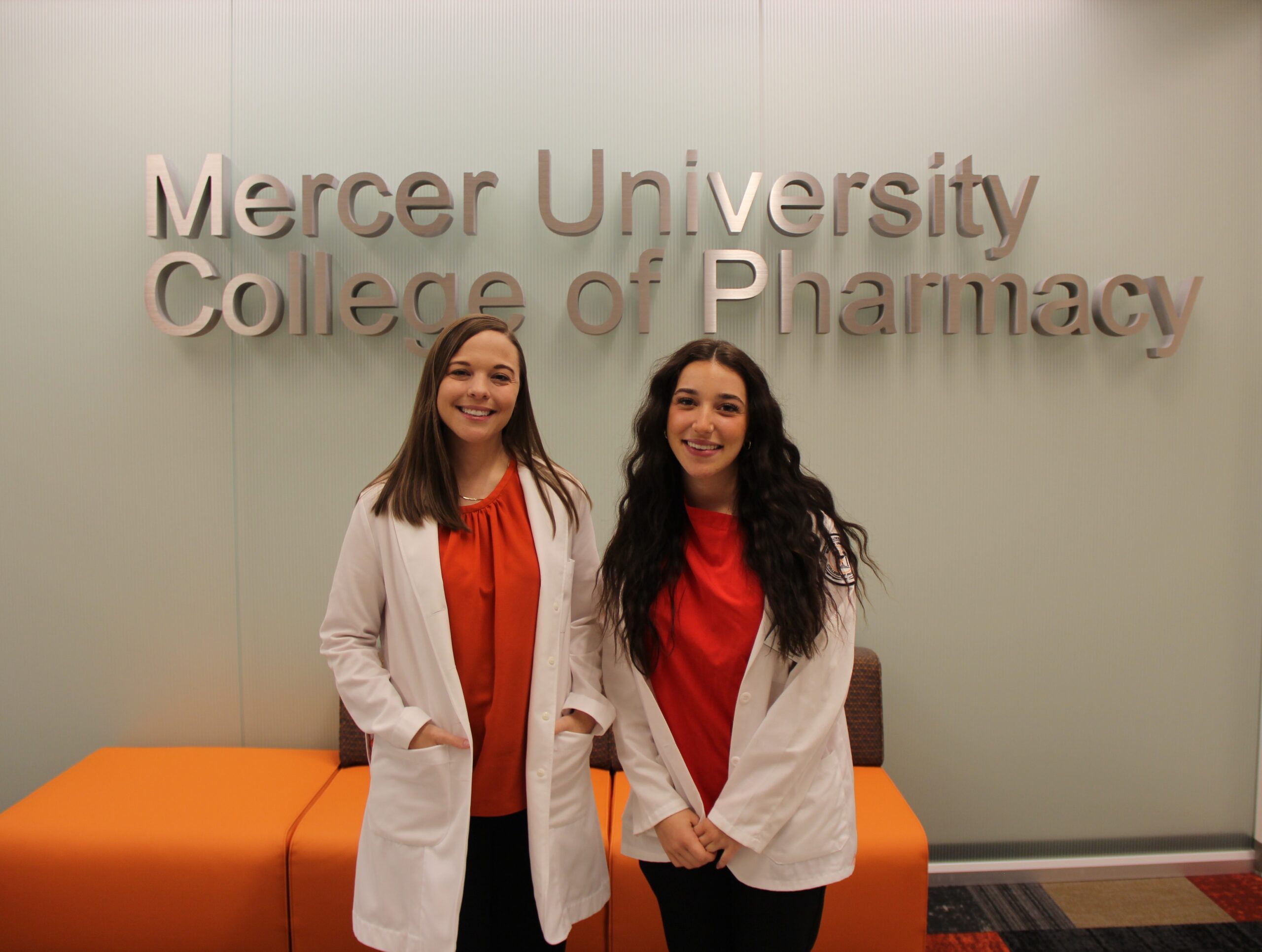
Among this year’s participants was Lena Piccolino, PHA ’29, who worked with Assistant Professor of Pharmaceutical Sciences Jenna Bloemer, Pharm.D., Ph.D., to write a narrative review on adiponectin-modulated autophagy in Alzheimer’s disease.
Bloemer, who has studied adiponectin’s effects in the brain, said the review builds on her broader research into the hormone’s potential as an Alzheimer’s treatment.
“We evaluated the literature surrounding how adiponectin enhances autophagy, and how this mechanism could be beneficial in the treatment of Alzheimer’s disease,” Bloemer said.
Piccolino started by building a foundation in the subject, reading background material on Alzheimer’s, adiponectin and autophagy before diving into the primary literature. She then learned to interpret the research techniques and data tables commonly used in the field.
“I read a lot of research articles and learned how to synthesize the data from them,” Piccolino said.
Once she grasped the material, Piccolino worked with Bloemer to outline the review before she began writing. She read around 50 articles over the course of the program, an exercise she said sharpened her ability to make sense of dense, technical data. The program also required her to give a formal presentation and reflect on her experience.
“A major part of the experience for Lena was learning how to critically read and evaluate scientific literature, synthesize findings across multiple studies, identify areas where additional research is needed and communicate scientific ideas effectively through writing and presentations,” Bloemer said.
Piccolino, who hopes to pursue a career in industry pharmacy, said she joined the program primarily to strengthen her resume and prepare for future job applications.
“I originally did it because I thought it would help me in the future,” she said. “Industry positions often demand comfort with reading and interpreting complex data sets.”
The pair plan to submit the manuscript, tentatively titled “Adiponectin-Modulated Autophagy in Alzheimer’s Disease,” to a neuropharmacology journal for publication.