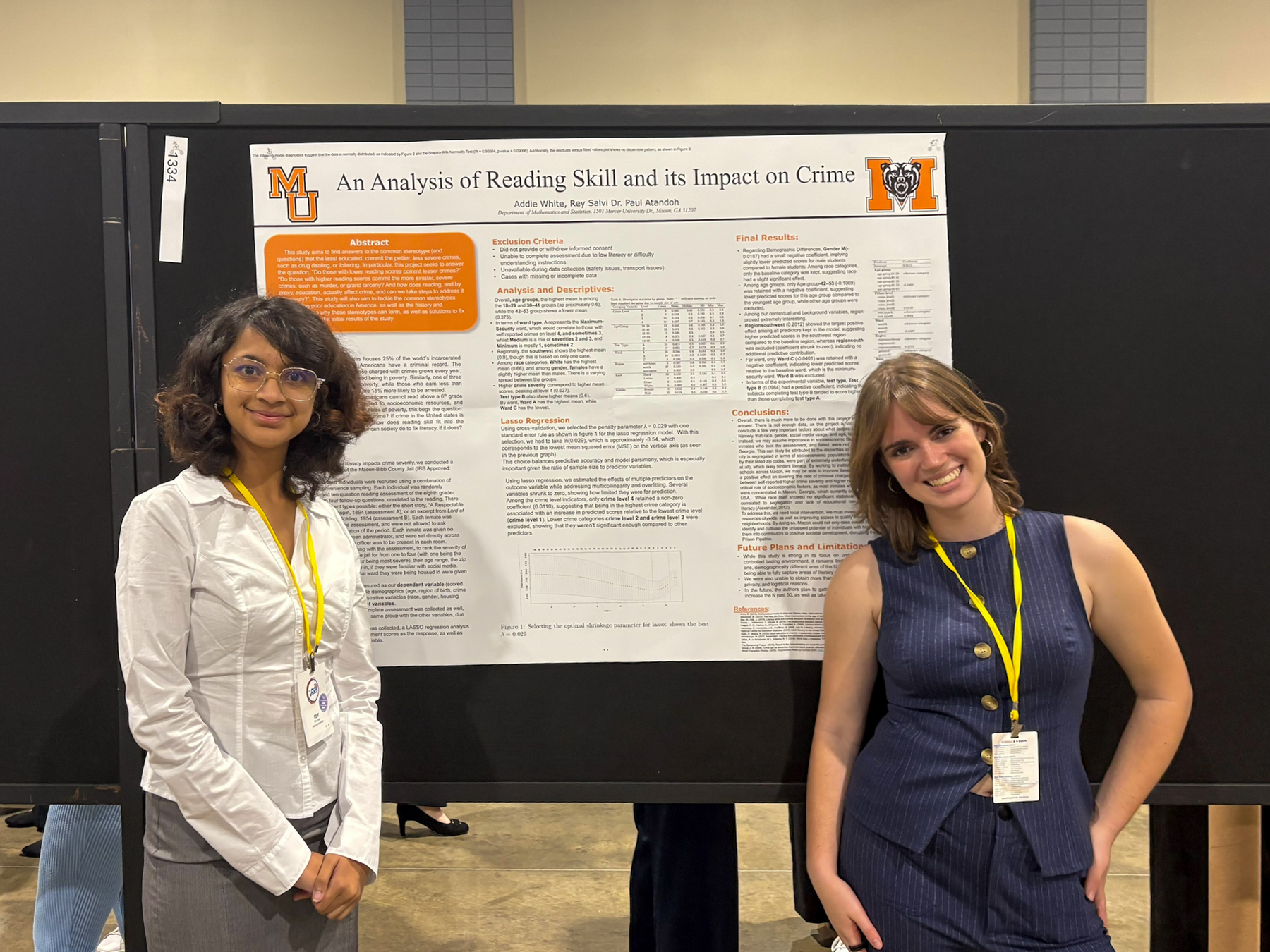
Mercer University student Addie White had a question. Is there a connection between the severity of a crime someone commits and that person’s reading level?
She went to the jail to find out.
Her work, under the guidance of Assistant Professor Paul Atandoh, Ph.D., has led to presentations locally and nationally, as well as a job at the Bibb County Sheriff’s Office.
“I always had an interest in more of why the crime happened rather than how to stop it, taking that analysis of why and then maybe bringing forward ideas of prevention,” she said. “I was so interested in the nitty-gritty. Why do people do what they do?”
White, CLAS ’27, grew up watching Law & Order: Special Victims Unit with her mom and was drawn to the character of Olivia Benson, a tough, smart and compassionate detective. The show is probably what first piqued her interest in criminology, she said.
Her high school fostered her interest in crime research, which she brought to Mercer as a double-major in statistics and sociology. At the beginning of her freshman year, she met Atandoh at a math and statistics department pizza party, where she told him about her desire to conduct crime research.
“My role as a professor was to guide her to narrow the broad research interest into a question that is more researchable,” said Atandoh, who created an independent study course to equip her with additional research skills and tools.
White came up with her research question after taking a class in which she learned about the school-to-prison pipeline — a concept to describe the path of some students from the education system to the criminal justice system — and the literacy rate in the United States.
She wondered if the assumptions and ideas surrounding the school-to-prison pipeline were true. That is, if people who commit pettier crimes are more likely to have poor reading skills, and conversely, if people who commit more severe crimes are more likely to have strong reading skills.
Since the data she needed was not already available, White designed a study. After obtaining Mercer University Institutional Review Board approval and permission from the Bibb County Sheriff’s Office, she conducted five site visits and administered a survey and reading-comprehension assessment to 41 consenting participants.
Over the course of five site visits, she gave a survey and reading assessment to 41 inmates who gave their consent to participate. Sometimes Atandoh or White’s research assistant, Riya Salvi, CLAS ’28, helped administer the tests.
White’s statistical analysis of the data found that inmates who reported being jailed for more severe offenses generally showed higher reading comprehension scores compared to those charged with less severe offenses. More research is needed to better understand the correlation, she said.
“I admire Addie’s genuine curiosity and her willingness to go beyond the classroom, to do something outside her comfort zone, to go to the prison — a place where most students really don’t want to go,” Atandoh said. “As the project kept going, she became more confident, and she became more interested, and she was asking questions. And how she communicated the results was so impressive.”
White’s project also showed the power of statistics and research working together, from study design through the communication of results, he said.
“Statistics is not just merely about crunching the formulas and doing the math all the time,” he said. “It also answers questions that matter to communities, and it helps students to explore and discover possible careers.
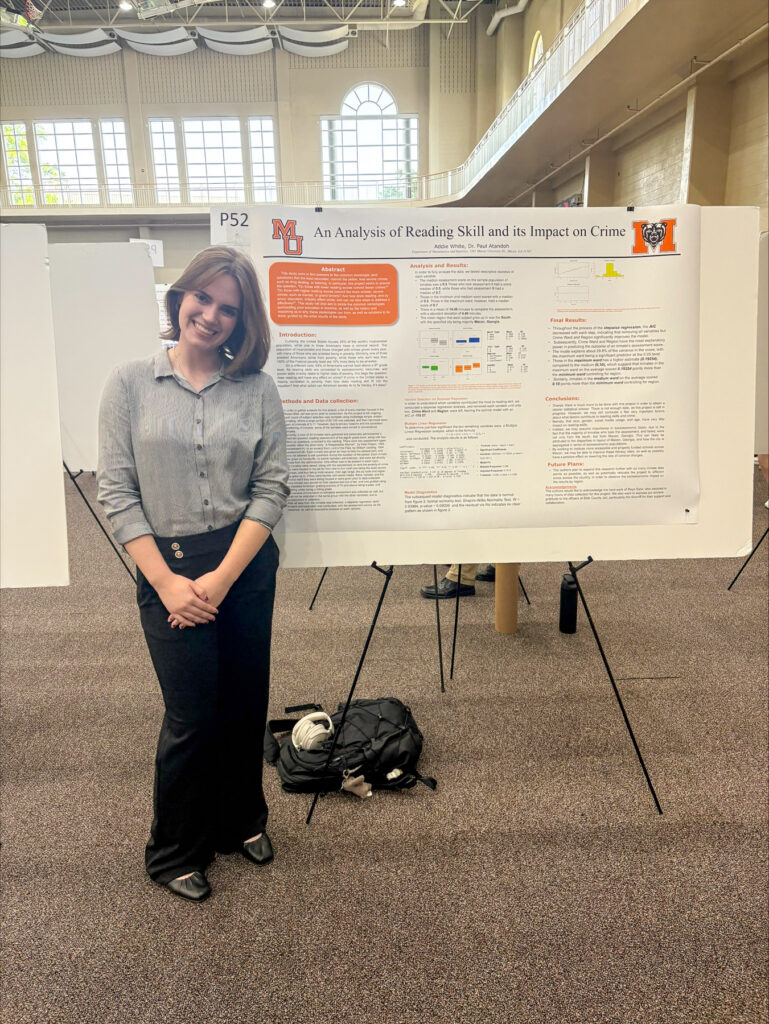
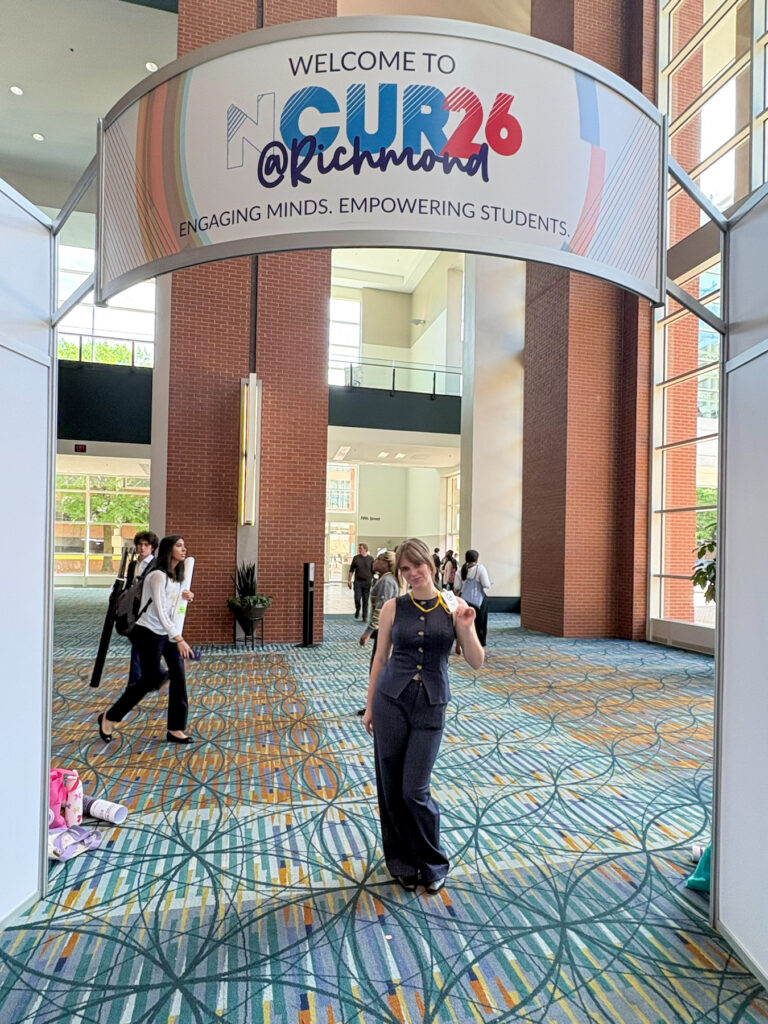
White presented her project to the math and statistics department and at Mercer’s BEAR Day in spring 2025. In spring 2026, she presented at the National Conference on Undergraduate Research in Richmond, Virginia.
“She is such a smart, intelligent person,” Salvi, a global health studies major, said of working with White. “It was inspiring because she was managing to keep up with all of these difficult classes and all these difficult courses while also being able to take on such a big project. I am very happy and proud to call her a mentor.”
White also presented her work to the Bibb County sheriff, which led to her being hired part time to conduct crime research. The research focuses on surveying jail inmates on their social and educational upbringings and cross-referencing that with location information.
“By the end of it, I’ll be able to take all that information and gather enough data for the sheriff himself to use on city proceedings, especially with targeting which areas in Macon need a lot more educational help,” White said.
She later was asked to work as a bailiff on cold cases, which involves reading through the files, looking for leads, creating summaries and categorizing them.
“She is helping our cold case investigators do a lot of follow-up work and administratively reorganize our cold cases, so we can get them in a better situation so that we can do a more thorough investigation on older cases that we haven’t been able to bring a closure to,” said Capt. Shermaine Jones, who works in the criminal investigations division of the Bibb County Sheriff’s Office.
White plans to earn a master’s degree in criminology or statistics, which would allow her to apply to be a special agent with the FBI. She is also applying for a Fulbright scholarship to study artificial intelligence crimes in South Korea.
In the future, she’d like to continue the research she started at Mercer in another city.
“I’m definitely not done with it,” she said. “That project specifically tackles a lot of issues and shows a lot of really important information that we need to put out there and we need to know if we want to help both with the prevention of crime and literacy rates.”