I have been thinking about perspective on the horizon of this new semester.
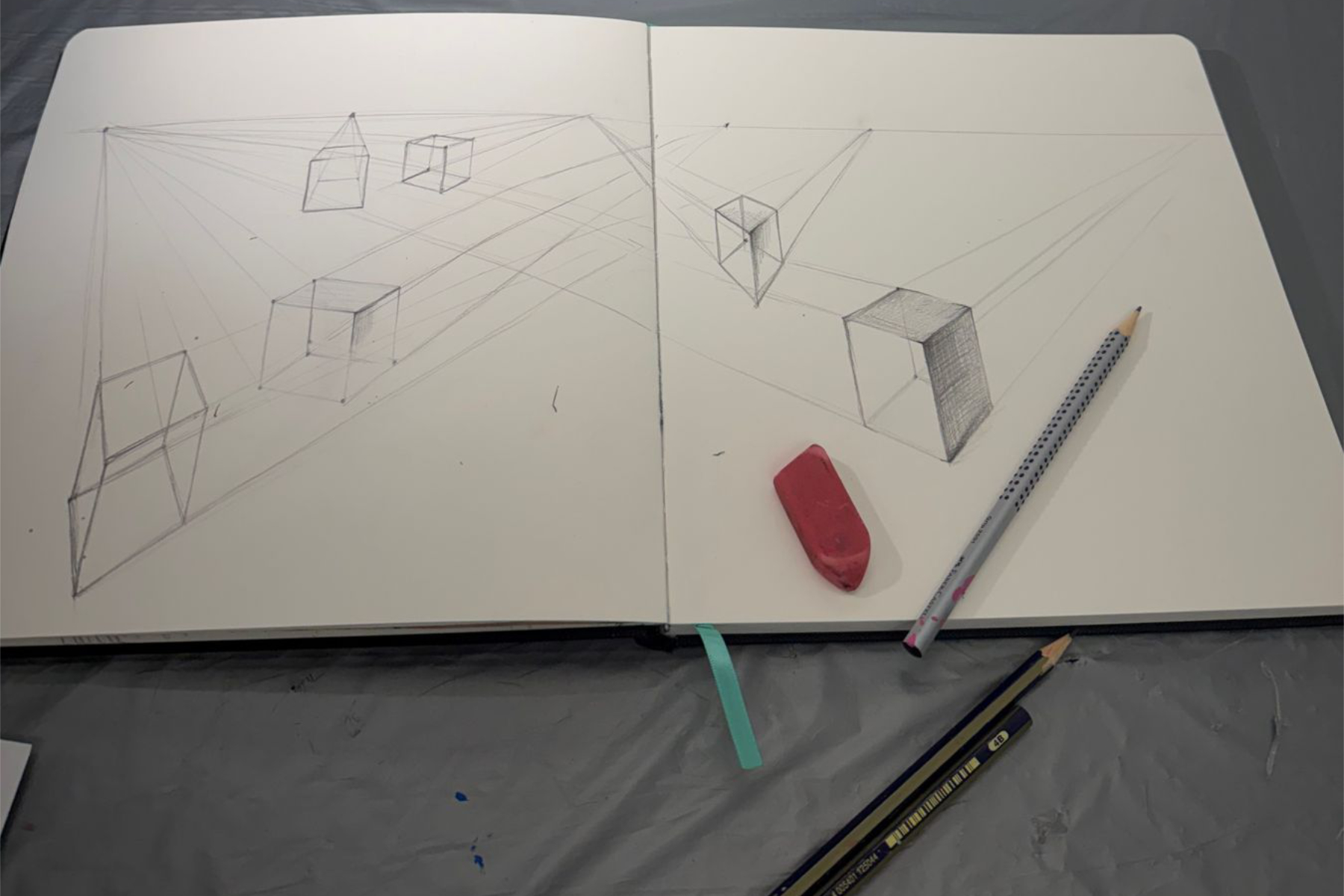
I first learned about perspective in Mr. Lantz’s seventh grade art class. He taught us how to turn a flat square drawing into a 3D-looking box. He called the technique perspective.
You remember it, don’t you? Start with a square. Draw a horizon line somewhere across the paper. Then put a point anywhere on that line. Draw straight lines from the corners of the square to the point. Make two quick perpendicular lines — one across the top, another down the side. Instantly, the flat square morphs into a 3D box. Incredible!
Here’s what’s even more amazing …
None of us students had the same shaped box. Some boxes were squatty; others were stretched out. Some turned right; others turned left. How could that be? We all started with the same square located in the same spot on our mimeographed papers, yet none of us ended up with boxes that looked alike. Each was different. Why?
Mr. Lantz had given us all the same square, but he hadn’t given any of us the perspective point. We got to decide where to place that. We could put it anywhere we wanted — high or low, right or left. It was totally up to us. It was the placement of our perspective point, not the square, that made the difference.
Carl Jung, the Swiss psychotherapist, famously observed, “It all depends on how we look at things and not how they are in themselves.”
This summer I joined our Mercer On Mission Costa Rica program for an intriguing project in the rain forest. Along the way, I met a remarkable woman — a kindly grandmother named Carmen. Several of our students were doing a home-stay with her. She invited to me to join them for supper one evening. I was alerted by Debbie Blankenship, director of the Murphy Center for Collaborative Journalism, that Carmen would likely have her severely disabled granddaughter, Alessa, with her.
Sure enough, while we were sitting at the table that night, Alessa appeared unannounced. My heart stopped the instant I saw her. I immediately understood Professor Blankenship’s caution. Alessa suffered from hydrocephalism and bore the disfiguring marks of her condition. Her head was unusually large and squarish. Her eyes protruded starkly. Her arms and shoulders had endured numerous surgeries, forlornly hoping to reshape them into a more normal orientation. Being 10 years old and profoundly autistic, Alessa politely obliged our awkward introduction for as long as she could bear it. Then she was off.
Carmen began telling us about all the trauma Alessa had experienced and the challenges she had yet to face. Then this devoted grandmother, who had to do absolutely everything for her granddaughter, crossed her arms, looked heavenward and smiled.
“To me, she is beautiful,” she said. “She is a gift of God. I see her,” pointing to her heart, “through the eyes of love.”
I melted.
How could anyone have seen Alessa that way? But, Carmen did. This was the perspective, the point of view, Carmen chose. She could have seen Alessa through the teary eyes of pity or the weary eyes of complaint. Instead, she chose to see through the wide-open eyes of love.
I’m sure our students learned much from their experience in the jungle, but I bet they would tell you that their most impactful learning was about perspective — how we see — and how we have the power to choose our perspective, and how that choice changes everything.
As we stand on the horizon of this new semester, I am thinking about perspective. How will we choose to see our colleagues and classmates, our work and our university? Will we choose to see each as burden or gift? Will we choose to see through the eyes of fear or hurt, suspicion or jealousy? Or, will we choose to see through the eyes of love?
We may not be able to change the square we are given, but we can surely choose the perspective from which we see it. Mr. Lantz, Carl Jung and dear Carmen all remind us that it is the perspective we choose that makes all the difference.
Who knows what surprising joys may come, if we gather the courage to see through the eyes of love.