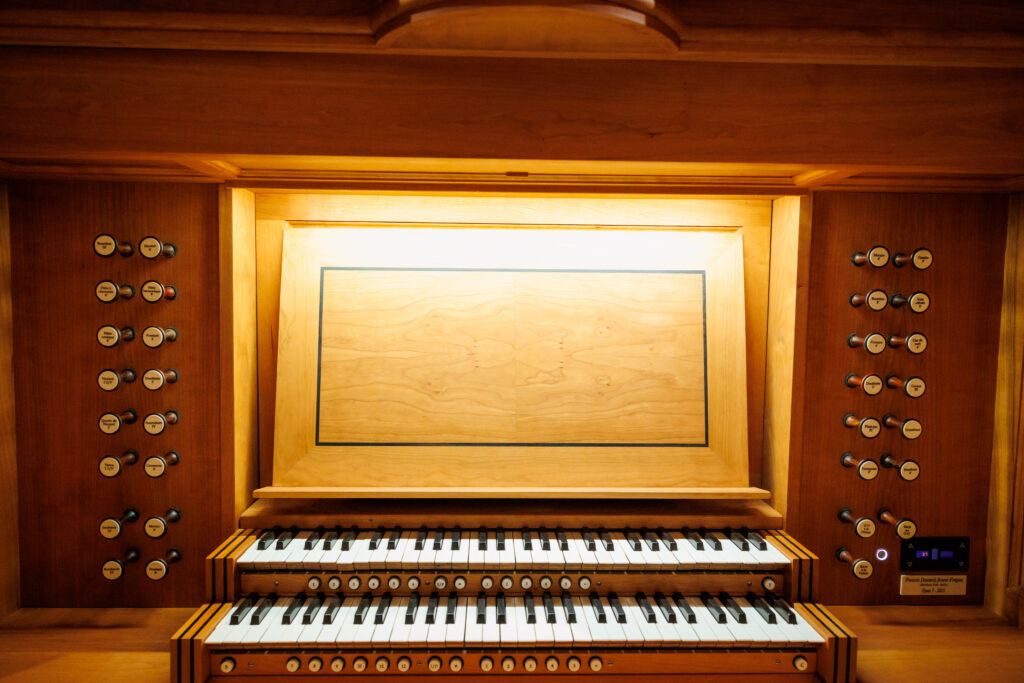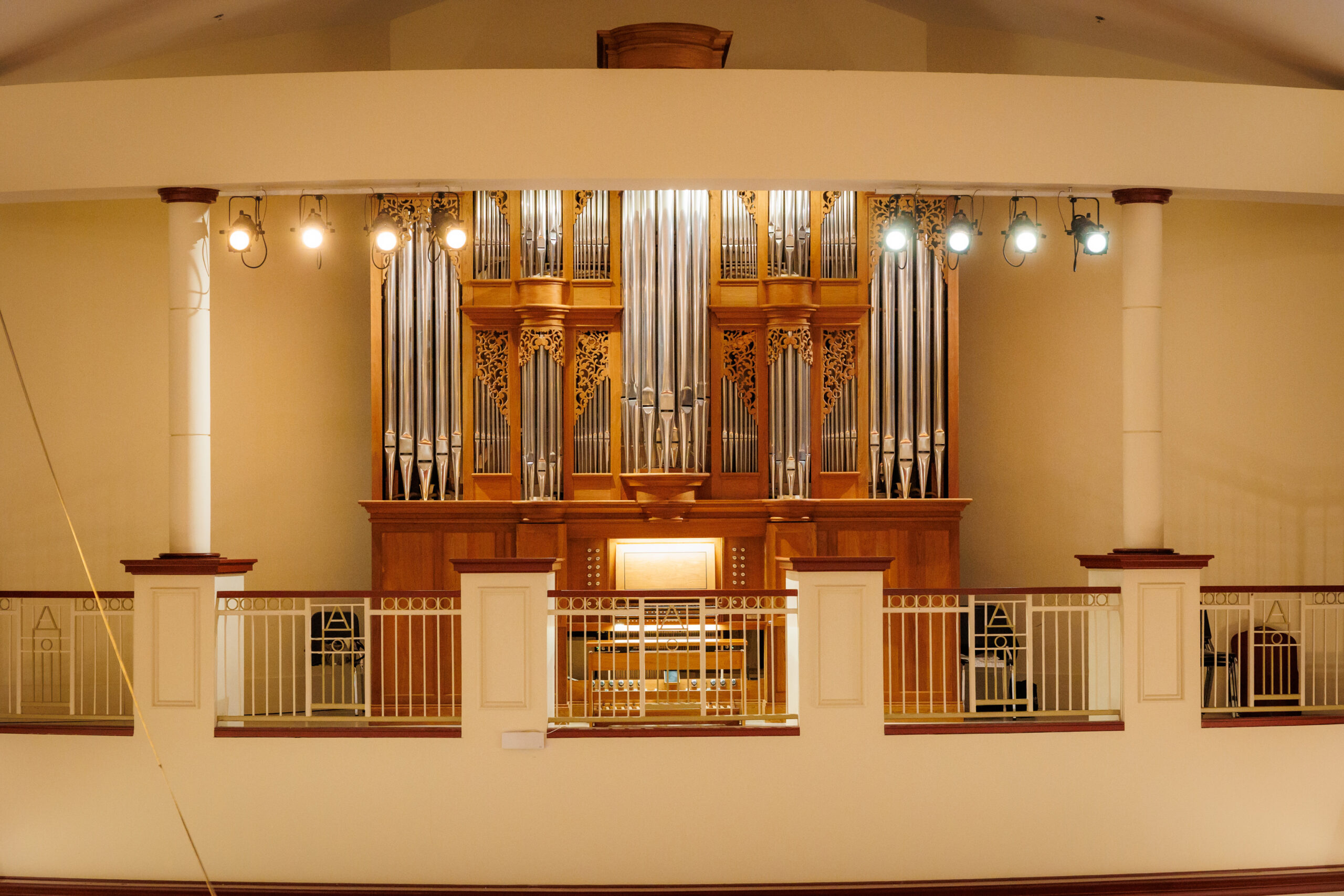
A custom-built organ recently installed in Neva Langley Fickling Hall is bringing new sounds and opportunities to Mercer University’s Townsend School of Music. The instrument features a solid cherry case and 1,693 wood and metal pipes, all situated in the building’s balcony.
The community is invited to experience the organ during a dedicatory recital performed by Dr. Jack Mitchener, chair of keyboard studies and professor of organ, at 4 p.m. Nov. 9.
“Having a new organ installed on campus has wonderful benefits for everyone,” School of Music Dean Dr. Gary Gerber said. “The students have an opportunity to play a new organ with beautiful and inspiring sounds; the Townsend School of Music can use the instrument as a solo instrument or accompany other soloists and ensembles; the University can use the organ for special campuswide events; and the Macon community will hear concerts presented by our students and faculty as well as hosting organ-related conferences and gatherings. This new organ will bring a new dimension to our School and University.”
When the organ in Newton Chapel was restored a few years ago, artisan organ builder François Desautels stepped in to finish the project after the initial builder, Hal Gober, retired. Dr. Mitchener said he was so pleased with the work that he started talking with Desautels about building a new organ for Fickling, which is the principal performance venue for the music school.
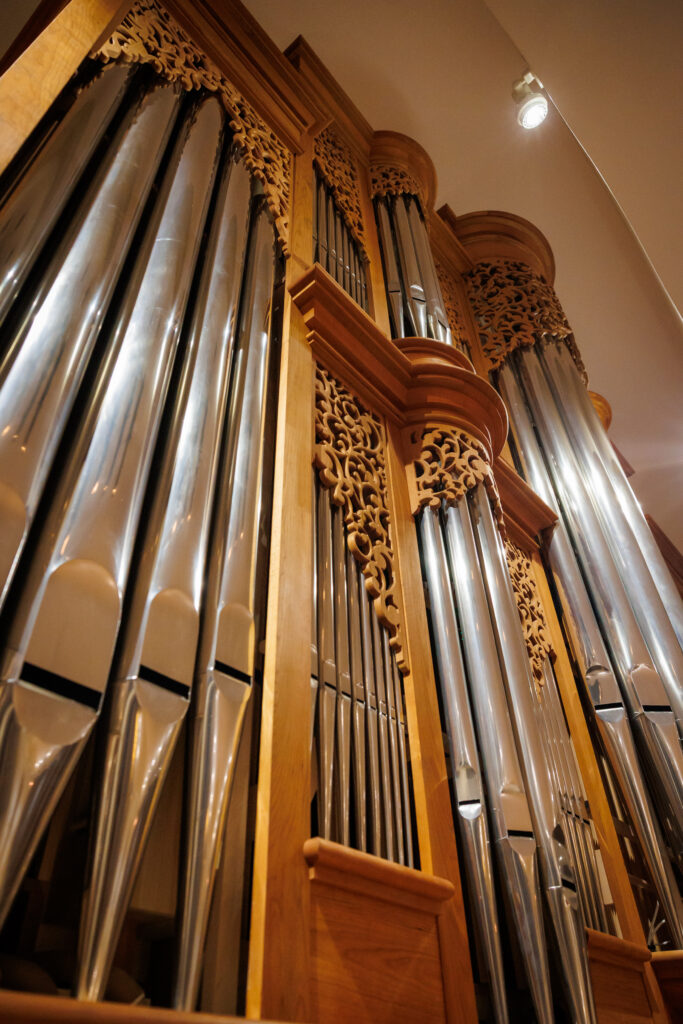
“He’s a true artist. His workmanship is really quite extraordinary,” Dr. Mitchener said. “When you look at this new organ and you see the craftmanship, the woodwork, the detailed carvings, the beautiful façade pipes, you see it as a true work of art.”
Since its construction in 2003, Fickling Hall has housed a small organ built by Richards, Fowkes & Co. in the style of Dutch organs from the late Renaissance and the early Baroque periods. Originally located in Ware Hall, the instrument has one manual keyboard for the hands and a pedalboard for the feet.
“It’s a very beautiful organ, but … the challenge for us has been that despite the fact that it plays 16th and early 17th century literature exceedingly well, it is not as successful for the vast majority of our repertoire. For the students, it has been my goal all along to put a larger organ in that space,” Dr. Mitchener said. “I wanted to have an organ that first and foremost was eclectic so that students could play just about anything on it. The space is limited, but it’s about as big as we could make it.”
The organ project was realized through major support from Carolyn Townsend McAfee Bruner, of Macon, a longtime organist and supporter of Mercer and its Townsend School of Music. Dr. Henry Sauls of Bradenton, Florida, and other donors interested in organ education and performance also contributed to the project.
“I have a passion for music education,” Bruner said. “I enjoy encouraging young musicians, and I think having the quality organs that we have will be just more enticing for people to come and study at Mercer. Jack Mitchener is an outstanding teacher and person, and I’m anxious to do all that we can to make him happy and have the kind of instruments that he would like to have for his students.”
Desautels and Dr. Mitchener collaborated on the organ design for about six months, and then Desautels spent two years building the instrument in his workshop behind his home near Montréal, Canada. Desautels said he has been building organs for 30 years and specializes in tracker organs, which have a mechanical link between the keyboards and pipes.
“I like building things from the beginning with raw materials from start to finish and having a musical instrument at the end,” Desautels said.
Bruner had the chance to visit with Desautels and see the unfinished instrument while she and husband Jim were in Montréal in October. Then in May, Dr. Mitchener played the finished instrument in Desautels’ workshop.
“It was a once in a lifetime thrill to get to be in a workshop,” Bruner said. “François is such a talented but humble person. Seeing how one man did all of these delicate, intricate details of the inside workings of the organ was just beyond expression to me. I had been an organist for a long time but never had seen one being built.”
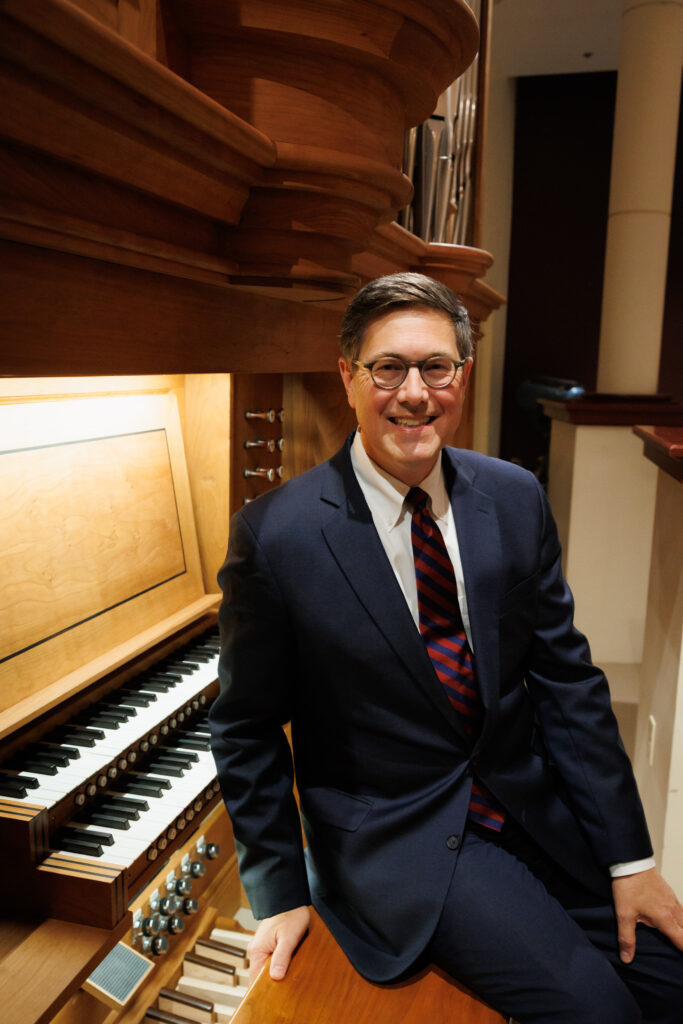
The organ has two manuals and a pedalboard, making it distinctly different from the other Fickling organ. It has 27 stops, which activate specific pipes, with names written on them in French, making it an “eclectic organ with a bit of a French accent,” Dr. Mitchener said.
“This (organ) is more pure the way it’s built, the way it plays, the kind of organ you would expect in a church building in the 1700s,” Desautels said. “This is unique on the campus. Students can come and play on it, and if they go elsewhere, they know what to expect and know how it can sound.”
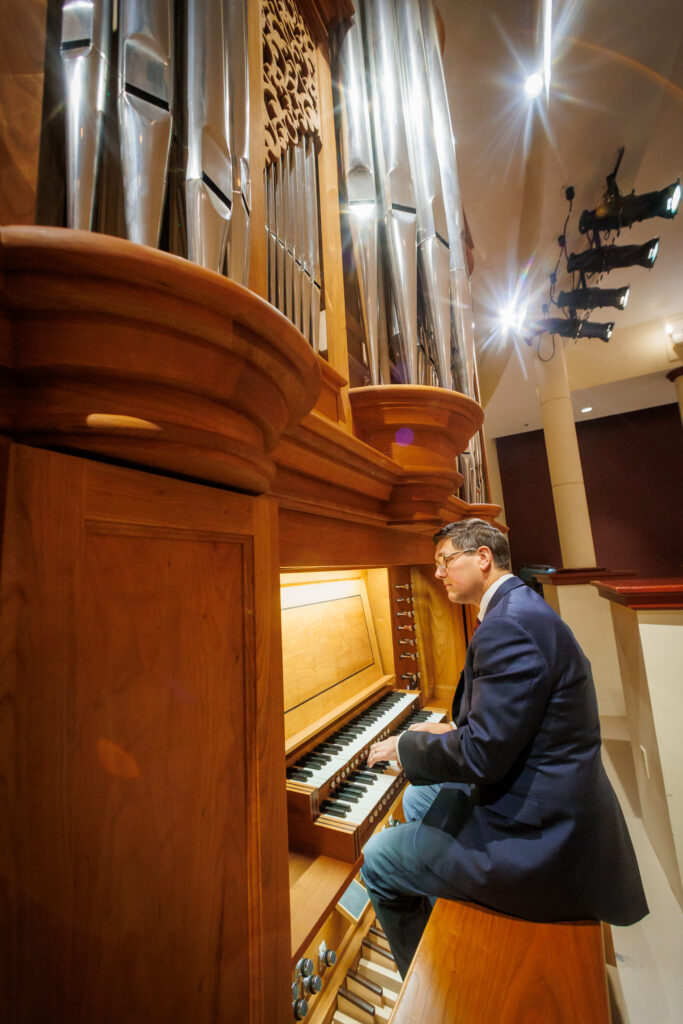
Once Desautels completed the organ in Canada, he disassembled the instrument and packed up the pieces in a tractor-trailer to transport them to Macon. Desautels and his son, Vincent, arrived with the truck on June 30. Over the course of about 10 days, they unpacked and installed the organ with the assistance of Dr. Mitchener and his son, Sanders; Mercer junior Eduardo Brand; David Kenney, father of a Mercer student; and a team of Physical Plant employees.
“We’ve really been needing an instrument like this,” Brand said. “It gives us more variety in the kinds of instruments we have around campus, and the quality of the action, the feel of playing it is really very different from any other organ we have on campus. As we use it more and play with different ensembles and vocalists, it gives us so many opportunities to use the instrument in more ways than we did before.”
The small organ already in Fickling was relocated within the hall, and the new one was put in its place in the balcony. Because of the tight spacing of the balcony and its narrow access stairs, they had to use a hydraulic lift to get many of the parts into position, Dr. Mitchener said.
After the installation, about 20 days were spent making sound adjustments, called “voicing the organ.” An organ’s sound often changes as it adjusts to humidity and air quality levels in a space, so Desautels will return in October to make any final tuning tweaks that are needed.
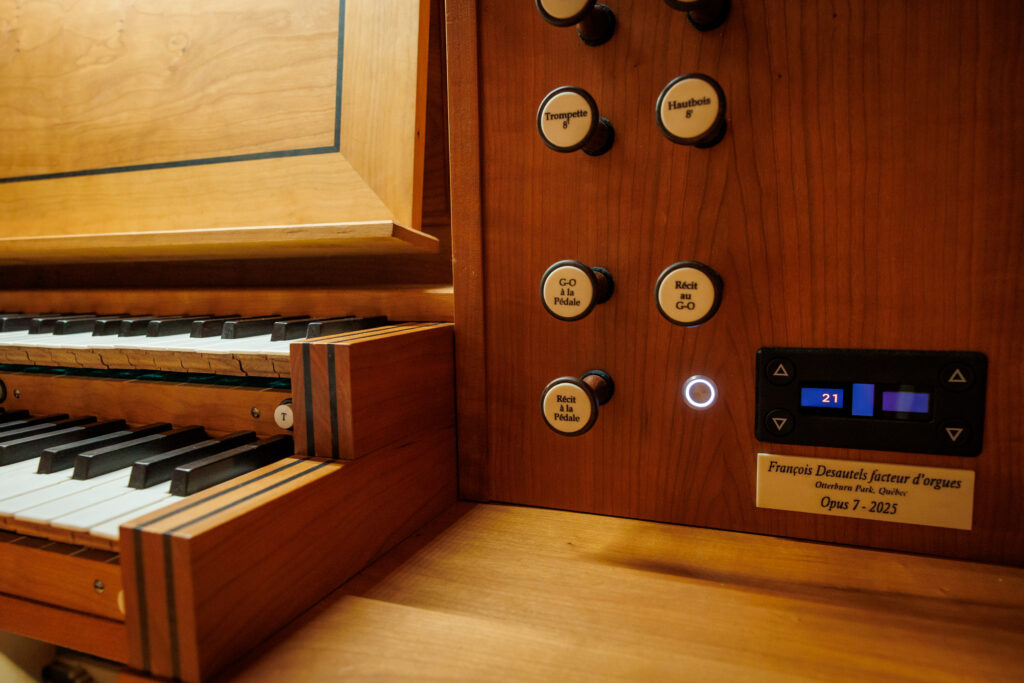
Brand, an organ performance major, has been doing organ maintenance since he started playing the organ at his home church in Houston, Texas. He spends his summers working as an apprentice organ builder for Richards, Fowkes and Co. in Tennessee and fixes Mercer’s organs when issues arise. The new Fickling organ was his first time working on the installation of a brand new pipe organ.
“It was an extremely edifying experience, both as a craftsman and a musician,” said Brand, who has continued maintenance of the new Fickling organ since its installation. “As the organ was taking shape, we would play the instrument and we would talk with François about the process and how we wanted the organ to sound. It’s a process that’s very artistic in itself.”
The new organ was first heard by the public at the School of Music’s faculty gala in August, during which Dr. Mitchener performed two pieces. It will make its official debut during an inaugural concert on Nov. 9, which Desautels plans to attend.
“It’s such a beautiful instrument to look at as well as to hear. I think the students will benefit greatly from having this quality of instrument to practice and learn on,” Bruner said.
In addition, plans are underway for a historic Skinner Organ Opus 190 to be installed in Toney Auditorium of Willingham Hall. Building renovations are tentatively scheduled to start in summer 2026, and the organ is poised to arrive in July 2027, Dr. Mitchener said.
The School of Music also has practice organs by Juget-Sinclair, Noack, and Richards, Fowkes & Co., as well as an organ by Victor Gonzalez that was donated by Michel Snethlage and shipped from Paris in 2012.
“I’m thrilled that in two years, we will have a very diverse, very interesting and significant collection of organs,” he said. “This is invaluable to our students as they prepare for careers in sacred music and organ performance. It’s very important for them to be exposed to different styles of instruments.”